 ultimate-guide
Aerial Cinematography for Event Production: A 2026 Guide
Table of Contents
- Why Aerial Cinematography Belongs in Event Production
- Drones vs. Helicopters: Choosing Your Aerial Platform
- FAA Part 107 Drone Regulations for Events
- Building a Cinematic Drone Shot List for Events
- Hiring Professional Drone Operators for Events
- Weather Contingency and Live Broadcast Integration
- Frequently Asked Questions
Last Updated: September 15, 2026
Why Aerial Cinematography Belongs in Event Production
Aerial cinematography is the practice of capturing moving images from aircraft or drone-mounted camera systems to tell a visual story from above. For event production, it turns a flat record of a stage and a crowd into something with scale, movement, and drama that ground-based shots simply cannot match.
At Phoenix Drone Pros, we have spent over a decade flying commercial missions, and the pattern is consistent: organizers who add an aerial perspective to their event coverage end up with footage that works as marketing for years after the last speaker leaves the stage. A single bird's-eye view of a packed venue communicates attendance and energy faster than any wide shot from the floor.
The payoff goes beyond a highlight reel. According to FAA drone operations guidance, commercial drone flight in controlled airspace requires specific authorization, which is why professional operators build compliance into the plan from day one. That same discipline is what makes aerial footage usable for video marketing, sponsor recaps, and next year's ticket sales.
Drones vs. Helicopters: Choosing Your Aerial Platform
Drones are the right choice for most events; helicopters only make sense for very large outdoor venues or broadcast productions with a budget to match. The decision comes down to altitude needs, noise tolerance, and how close you need to fly to people and structures.
Multirotor drones hover, fly low, and thread through venue layouts with precision. They are quiet enough for many outdoor settings and can launch from a small staging area. Helicopters and fixed-wing aircraft cover more ground and reach higher altitudes, but they cost far more to operate, need a landing zone, and cannot hover close to a crowd.
| Platform | Typical Operating Altitude | Endurance Per Flight | Noise Profile | Best For | Key Limitation |
|---|---|---|---|---|---|
| Multirotor drone | Ground level to 400 ft AGL | Roughly 20-45 minutes per battery set | Low; often inaudible over amplified stage audio | Concerts, festivals, corporate events | Limited flight time per battery |
| Helicopter | 500 ft AGL and above | 1-3 hours depending on fuel and payload | High; can overwhelm on-stage audio and interviews | Stadium-scale broadcast, wide venue sweeps | High cost, noise, no low hovering |
| Fixed-wing aircraft | 500 ft AGL and above | 2-6 hours depending on airframe | Moderate at altitude, minimal on the ground | Large outdoor site mapping | Cannot hover or fly low |
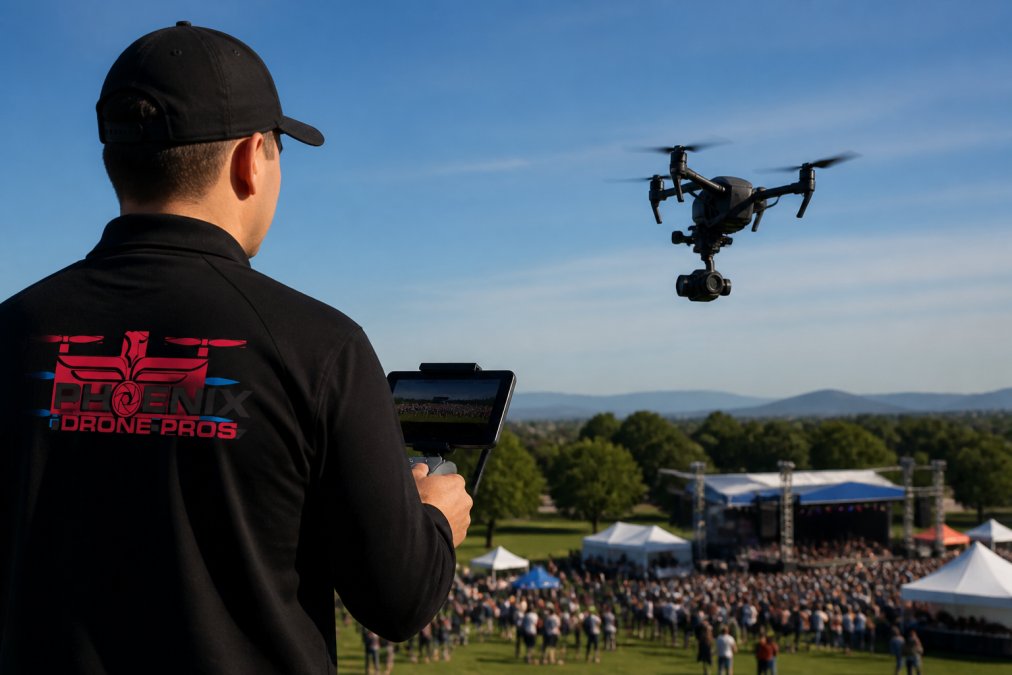
The 400-foot figure in the drone row is not a suggestion; under FAA Part 107 overview, 400 feet above ground level is the standard ceiling for small unmanned aircraft in uncontrolled airspace, and it is the practical ceiling for most event work. That altitude is usually more than enough. A drone at 200-300 feet over a festival main stage captures the full crowd footprint and the stage in one frame, which is exactly the scale shot organizers want.
Helicopters earn their cost when the venue itself is the story: a stadium bowl, a golf course, a sprawling campus, or a broadcast that needs a continuous high-altitude feed for hours. They also carry heavier cinema camera packages and can stay airborne far longer than a battery-powered drone. The trade-off is that a helicopter cannot descend into the 50-150 foot band where the most cinematic event shots live, and its rotor noise will bleed into any audio being recorded nearby.
Fixed-wing aircraft are a niche tool for events. They are useful for mapping a large outdoor site before build-out or capturing a wide approach to a remote venue, but they cannot hover, cannot fly low, and cannot produce the stabilized, gimbal-smooth footage that event marketing depends on.
For nearly every event production, a drone services team with gimbal technology and 4K resolution cameras delivers the stabilized footage you actually want. The practical rule most event producers land on: book a drone crew for anything inside the venue footprint, and only consider a helicopter when the venue is so large that a drone cannot frame it in a single shot.
FAA Part 107 Drone Regulations for Events
FAA Part 107 is the rule set that governs commercial drone flight in the United States, and it applies to every paid event shoot. A remote pilot must hold a Part 107 certificate, keep the aircraft within visual line of sight, and avoid flying over people who are not part of the operation unless specific conditions are met.
The FAA Part 107 overview lays out the core limits: flights below 400 feet in uncontrolled airspace, no operations from a moving vehicle, and no careless or reckless flying. Flying over crowds at a festival or concert triggers additional requirements, and many venues sit inside controlled airspace near an airport, which means the operator needs airspace authorization before launch. A reputable team handles this paperwork well ahead of the event date.
Building a Cinematic Drone Shot List for Events
A cinematic drone shot list is a written plan of every aerial shot you need, mapped to the event schedule so the pilot knows exactly where to be and when. Building one separates a professional shoot from a random flight.
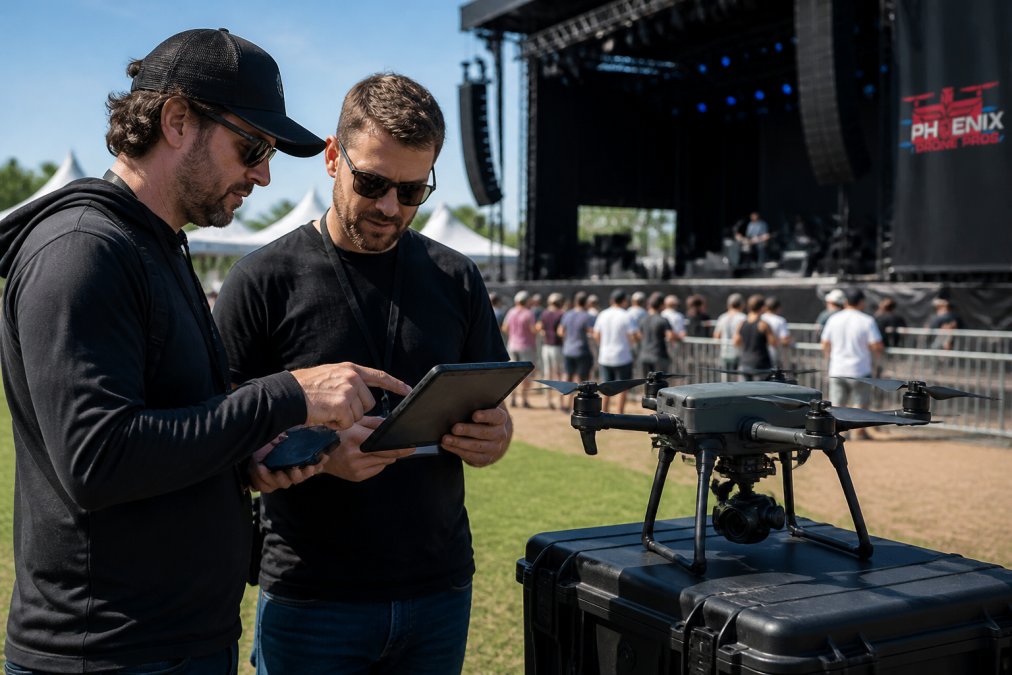
Start with the story you want to tell, then match shots to moments:
- Establishing shot - a slow push-in over the venue that shows the full layout and attendee scale.
- Reveal shot - rise over a stage or entrance to reveal the crowd as it builds.
- Tracking shot - fly a steady line along a queue, a midway, or a row of sponsor booths.
- Crowd shot - a high, stable hover that captures density and energy without flying directly over people.
- Detail pass - low, close passes over signage, staging, and decor for cutaway footage.
- Closing pull-back - a wide retreat that frames the whole site as the event winds down.
What most guides miss is timing. Golden hour light transforms an ordinary venue into something cinematic, so schedule your hero shots for the hour after sunrise or before sunset whenever the event allows.
Hiring Professional Drone Operators for Events
Hiring professional drone operators for events means vetting certification, insurance, and local experience before you sign a contract. The cheapest quote is rarely the safest one. This is also where most event organizers get exposed, because the liability for an aerial mishap does not stop at the pilot.
The Three Documents to Collect Before Booking
Ask every candidate for three things: a current FAA Part 107 remote pilot certificate, proof of liability insurance, and a portfolio of live event footage rather than real estate or landscape work. A common mistake is booking a general drone operator who has never worked a live event; they underestimate crowd movement, schedule pressure, and the need for backup batteries and a second pilot.
Insurance and Liability: The Gap Most Guides Skip
Most aerial cinematography articles stop at "make sure they're insured." That is not enough for an event organizer, because the organizer can be named in a claim even when the pilot is at fault. Here is what to actually verify. Beyond verifying insurance, you must confirm that the pilot integrates their flight path with your event visualization tools to ensure that every planned shot remains within the legal and safety boundaries of the venue.
Certificate of insurance (COI). Request a COI naming your organization and, if required, the venue as additional insured.
Contract Terms Worth Negotiating
Weather Contingency and Live Broadcast Integration
Planning for Wind, Rain, and Visibility Limits
Feeding Drone Footage Into Live Streams
Frequently Asked Questions
What is aerial cinematography in the context of live events?
Aerial cinematography uses drones or helicopters to capture video from above during an event. For live events, it means flying a camera over the crowd, stage, or venue to document attendee scale, venue layout, and the overall atmosphere. The footage is often combined with ground-based shots in post-production to create highlight reels, promotional videos, or live broadcast feeds. The goal is a bird's-eye view that ground cameras cannot achieve.
What FAA regulations apply to drone use at public events?
Commercial drone flights fall under FAA Part 107. Pilots need a Remote Pilot Certificate, must keep the drone within visual line of sight, and cannot fly over people who are not directly participating in the operation without a waiver. Many public events require coordination with local authorities and may need a Certificate of Waiver or Authorization. Flying over crowds without proper approval violates FAA rules and can create serious liability for event organizers.
How does aerial footage improve event highlight reels?
Aerial footage adds a sense of scale that ground cameras miss. A drone shot pulling back over a packed festival grounds or a corporate campus shows the full scope of the event in seconds. When editors cut between stabilized aerial footage and ground-based shots, the contrast creates visual rhythm and keeps viewers engaged. Event marketing teams use this footage for recaps, sponsor deliverables, and next-year promotion.
How do you integrate drone footage with ground-based event videography?
Integration starts with a shared shot list. The drone operator and ground videographers agree on angles, timing, and camera settings so the footage matches in color and frame rate. During the event, the drone team and ground crew coordinate over radio to avoid gaps in coverage. In post-production, editors sync aerial and ground clips to music or narration, using the drone shots as establishing frames and transitions between closer ground-level moments.