 ultimate-guide
Benefits of Drone Roof Inspections for Insurance Claims
Table of Contents
- Why Insurers and Adjusters Are Turning to Drone Roof Inspections
- How Drone Technology Works for Roof Inspections
- Safety and Efficiency Gains for Claims Adjustment
- Thermal Roof Inspection Benefits for Hidden Damage
- Storm Damage Claim Documentation: Post-Disaster vs. Routine Inspections
- Drone Roof Inspection Cost: What Affects Pricing and ROI
- Privacy, Legal Rights, and Regulatory Compliance for Homeowners
- Conclusion
- Frequently Asked Questions
Last Updated: September 16, 2026
Why Insurers and Adjusters Are Turning to Drone Roof Inspections
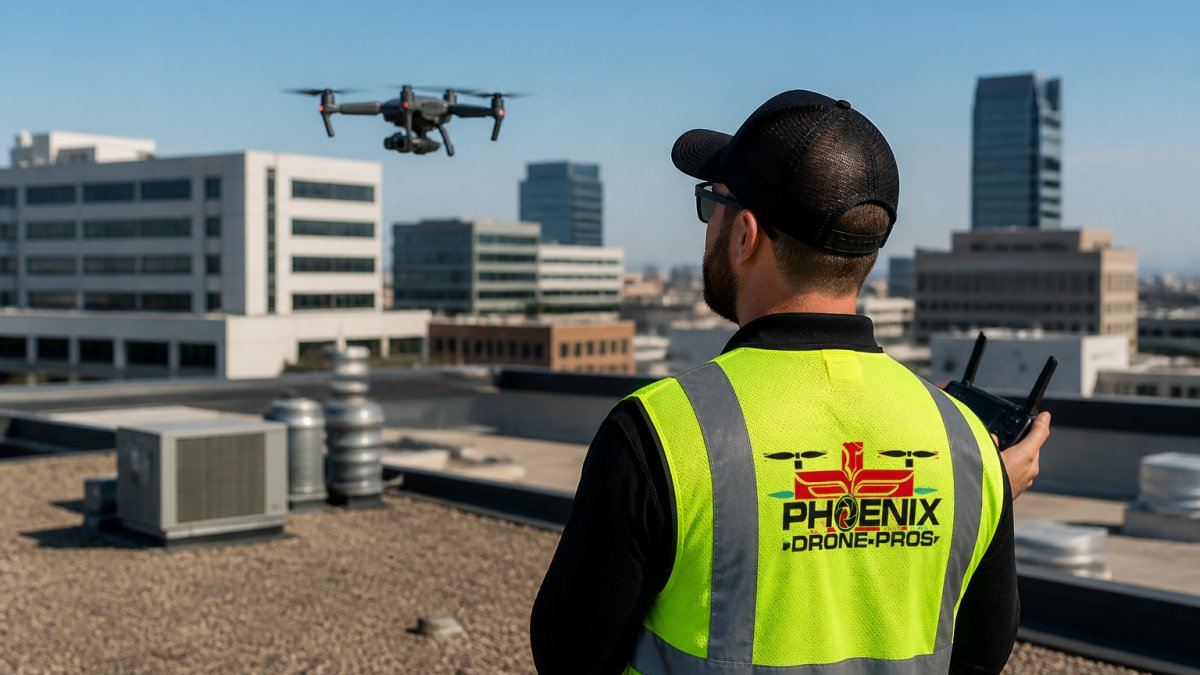
The benefits of drone roof inspections for insurance claims start with a simple problem: sending a person onto a steep, storm-damaged roof is slow and genuinely dangerous. Aerial assessment replaces much of that risk with a controlled flight and a set of high-resolution images. At Phoenix Drone Pros, our FAA-certified pilots have spent more than a decade capturing exactly this kind of documentation for homeowners, adjusters, and property managers.
How Drone Technology Works for Roof Inspections
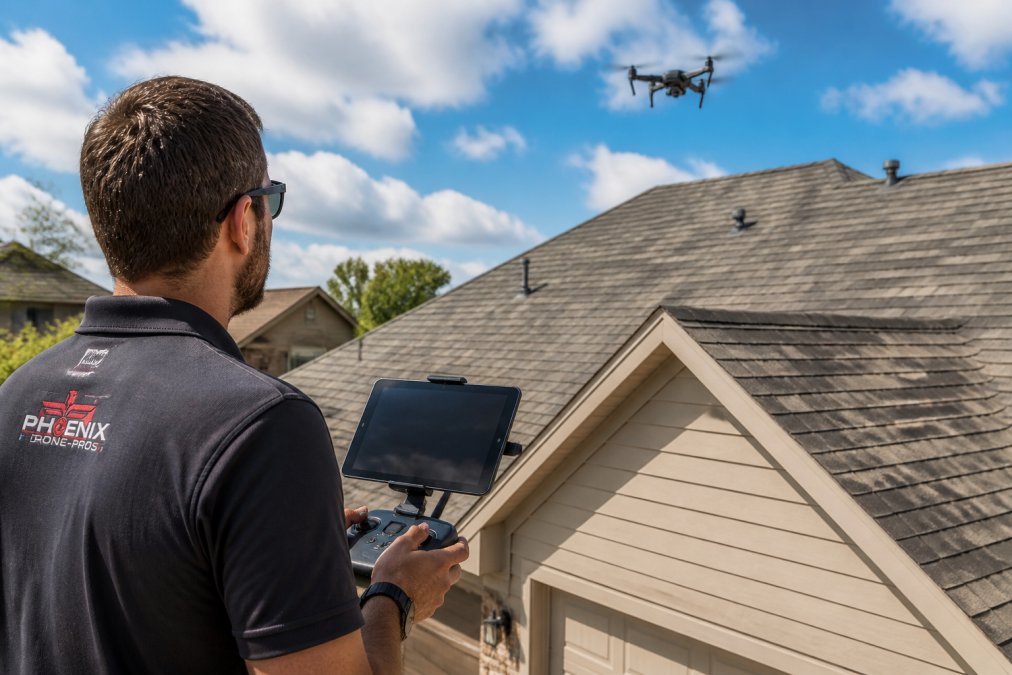
A drone roof inspection combines a certified remote pilot, an unmanned aerial vehicle, and a camera payload that captures overlapping images of every roof plane. The pilot flies a programmed grid pattern, then software stitches those images into a full roof condition report.
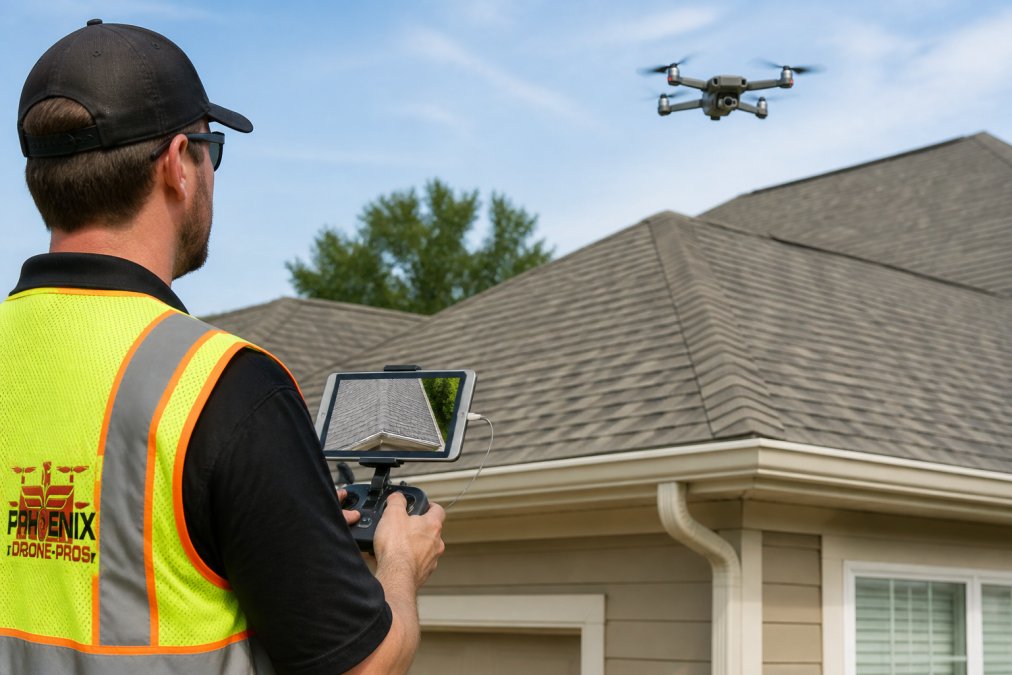
The workflow is straightforward:
- Pre-flight planning. The pilot checks weather, airspace, and any local flight restrictions.
- Grid capture. The drone flies overlapping passes to cover the full roof, including valleys and penetrations.
- Data processing. Images are stitched into an orthomosaic map, a single scaled image of the entire roof.
- Review. An inspector or adjuster marks damage, measures areas, and writes findings into the claim file.
Capturing High-Resolution Imagery and Data
Modern payloads resolve shingle granules, cracked flashing, and lifted seams that a ground-level visual inspection simply cannot see. High-resolution data also lets an adjuster zoom into a specific slope months later without a return trip.
Sensor Types: RGB, Thermal, and LiDAR
Three sensor types do most of the work in property damage assessment:
- RGB cameras capture true-color imagery for visible damage and documentation.
- Thermal imaging detects temperature differences that reveal water intrusion and hidden moisture.
- LiDAR measures roof geometry precisely, which supports accurate damage quantification and 3D modeling.
Safety and Efficiency Gains for Claims Adjustment
The clearest operational win is that nobody walks the roof. Falls remain a leading cause of serious injury in construction and inspection work, and drone assessment removes that exposure entirely for the initial survey, per OSHA guidance on fall hazards in construction.
| Traditional Inspection | Drone Inspection | Primary Impact |
|---|---|---|
| Adjuster climbs the roof | Pilot flies from the ground | Liability reduction |
| Notes and handheld photos | Orthomosaic and thermal data | High-resolution accuracy |
| Scheduling delays | Same-week flight windows | Faster claims settlement |
| Limited roof access | Full coverage of steep pitches | Better damage quantification |
Thermal Roof Inspection Benefits for Hidden Damage
Thermal roof inspection benefits show up where the eye fails. Infrared thermography reads surface temperature, and trapped moisture changes how a roof sheds heat. That difference appears as a distinct pattern in the thermal image, often before any stain shows up on a ceiling.
Storm Damage Claim Documentation: Post-Disaster vs. Routine Inspections
Storm damage claim documentation and routine maintenance inspections serve different purposes, and mixing them up weakens both. A post-disaster flight is a rapid evidence capture: fly fast, document everything, establish a timestamped record before cleanup begins. A routine inspection is a baseline: capture the roof in good condition so future damage is easy to prove.
Drone Roof Inspection Cost: What Affects Pricing and ROI
Drone roof inspection cost is not a flat rate. It scales with roof size, pitch, sensor package, and turnaround time, and it is best understood as a line item against the cost of the alternative, a manual roof walk, a lift rental, or a delayed claim decision.
What Actually Drives the Price
- Roof complexity. A simple single-family gable is the low end of the range. Steep pitch, multiple levels, dormers, and obstructions add flight time and processing time. Commercial flat roofs with HVAC penetrations sit in the middle; multi-building portfolios sit at the top.
- Sensor package. RGB-only capture is the baseline. Adding thermal imaging increases both flight time and post-processing, because the pilot has to capture matched visual and infrared frames and the analyst has to interpret temperature deltas. LiDAR adds a third layer of processing for geometry and 3D modeling.
- Turnaround. Standard delivery is cheaper than expedited reporting. A carrier that can wait a few days pays less per roof than one that needs same-day imagery for a catastrophe response.
- Volume and recurrence. Portfolio-wide or recurring inspections price better per property because mobilization and travel are amortized across more flights.
- Geography and access. Rural properties with long travel distances and urban properties with airspace restrictions both add cost, for different reasons.
How Insurers Frame the ROI
The ROI case is not just "drones are cheaper than people on roofs." It is a comparison of total claim cost across the lifecycle:
- Avoided fall liability. A single serious fall claim, medical, lost-time, and potential litigation, can exceed the cost of hundreds of drone inspections. That asymmetry is why carriers treat aerial capture as a risk-control measure, not just a convenience.
- Faster cycle time. Every day a claim stays open carries administrative cost and, in many states, regulatory prompt-payment exposure. Compressing the inspection phase compresses the whole cycle.
- Better documentation, fewer disputes. A timestamped orthomosaic and thermal set is harder to contest than a handwritten note and a few handheld photos. Fewer disputes means fewer re-inspections and fewer appraisals.
- Reusable record. The same imagery can support the initial claim, a re-inspection after repair, and the next policy renewal, one flight, multiple uses.
The Homeowner Side of the Math
For current rates and scheduling, Phoenix Drone Pros scheduling and pricing is the place to request a quote.
Privacy, Legal Rights, and Regulatory Compliance for Homeowners
Most content on drone roof inspections is written for the insurer. This section is written for the homeowner, because the privacy and legal questions are where trust is won or lost, and where competitors are thinnest.
The Federal Layer: FAA Part 107
Commercial drone operations fall under Federal Aviation Administration rules. A certified remote pilot must hold a Remote Pilot Certificate under Part 107, which sets the operating requirements: altitude limits, visual line-of-sight, daylight or civil-twilight operations with anti-collision lighting, and restrictions on flying over people and moving vehicles. The FAA's Small Unmanned Aircraft Systems rule lays out those requirements in full.
The State Layer: Privacy and Trespass
There is no single federal drone privacy statute that governs roof inspections. The rules that matter most are state-level, and they vary widely. Some states have enacted drone-specific privacy or trespass provisions; others rely on general privacy, nuisance, or intrusion-upon-seclusion doctrines. A few states have specific rules about surveillance of private property from the air.
What a Homeowner Can Reasonably Expect
- Scope. The drone captures the roof and exterior envelope, not the interior, and not the neighboring property beyond what is incidentally in frame.
- Consent. The homeowner should know when the flight is happening and who is flying. "Secret" inspections are a red flag, not a feature.
- Data handling. Imagery should be treated as claim documentation: stored securely, shared only with parties to the claim, and not published or used for marketing without written consent.
- Retention. Homeowners can ask how long imagery is kept and whether it can be deleted after the claim closes.
- Credentials. The pilot's Remote Pilot Certificate and insurance certificate should be available on request.
The Policy-Renewal Angle Competitors Skip
Routine inspections for policy renewal raise different questions than post-disaster claim inspections. A renewal inspection is closer to underwriting than to claims adjustment, and the imagery may influence premium, coverage terms, or insurability. Homeowners should ask, before a renewal inspection, how the resulting data will be used and whether findings will be shared with the underwriting side of the carrier.
Compliance Is a Feature, Not a Formality
Working with a fully insured, FAA-certified team removes most of the guesswork. The operator handles airspace, credentials, and data handling; the homeowner gets a clear answer to the only question that matters: who sees this imagery, and what happens to it afterward.
Conclusion
The gap between a slow, risky manual inspection and a fast, data-rich aerial one keeps widening, and insurers are noticing. Drone assessment cuts claims cycle time, reduces liability, and produces documentation that holds up under review. Phoenix Drone Pros brings FAA certification, full insurance, and more than ten years of commercial drone experience to every flight, with local pilots available for thermal roof inspections, storm damage documentation, and routine property assessments.
Frequently Asked Questions
Is a drone roof inspection worth it for insurance claims?
Yes, for most property claims. Drones capture high-resolution images and thermal data that document damage more thoroughly than a ground-level visual inspection. That evidence can reduce disputes over damage quantification and speed up claims settlement. For steep, fragile, or storm-damaged roofs, drones also eliminate the safety risk of sending an adjuster onto the roof. The main trade-off is that a drone cannot physically test materials, so a hands-on inspection may still be needed for certain structural findings.
Do insurance companies use drones to inspect roofs after a storm?
Many carriers now deploy drones for post-storm inspections because they can cover a property in minutes and produce consistent, timestamped imagery. After a hail or wind event, a drone can document shingle degradation, missing tabs, and water intrusion points across the entire roof plane. Some insurers also use aerial imagery for underwriting and policy renewal decisions. If your carrier does not offer drone inspections, you can hire an FAA-certified operator to create a roof condition report you submit with your claim.
How much does a drone roof inspection cost?
Drone roof inspection cost depends on roof size, pitch, accessibility, and whether you need thermal imaging or 3D mapping. Routine visual inspections are typically less expensive than thermal or LiDAR surveys, and emergency post-storm calls may carry a premium. Because pricing varies by scope, request a quote based on your property details rather than relying on a generic range. For insurance claims, compare the inspection fee against the potential claim value and the cost of a missed damage finding.
Are drone roof inspections more accurate than manual inspections?
For surface-level damage documentation, drones often match or exceed manual inspections because they capture consistent, high-resolution images from multiple angles. Orthomosaic mapping and thermal imaging can reveal moisture intrusion and insulation gaps that are hard to see from the ground or even on the roof. However, a drone cannot probe soft decking or test shingle adhesion. The most accurate approach combines aerial data with a physical inspection when the imagery flags a potential structural concern.