 ultimate-guide
Drone Inspection for Commercial Roof Maintenance
Table of Contents
- Why Drone Inspection Beats Traditional Commercial Roof Maintenance
- How Drone Roof Inspections Work: From Flight Plan to Report
- Thermal Imaging for Roof Leaks: Seeing What the Eye Misses
- FAA Part 107 Requirements for Roof Inspections
- Your Commercial Roof Maintenance Checklist After the Flight
- Equipment, Sensors, and What Drives Inspection Costs
- Frequently Asked Questions
Last Updated: September 10, 2026
Why Drone Inspection Beats Traditional Commercial Roof Maintenance
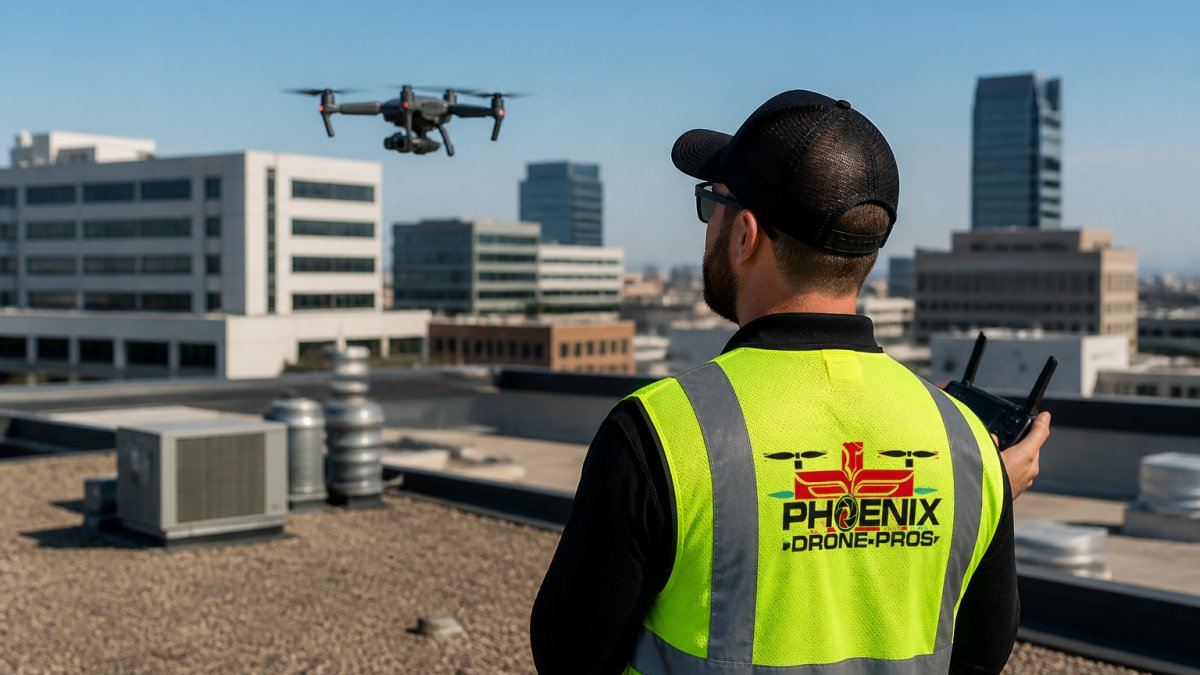
Commercial roof maintenance has a math problem. A single physical inspection of a large flat roof can take a crew half a day, require fall-protection setups, and still miss moisture hiding under the membrane. Drone inspection for commercial roof maintenance solves that by putting a camera and thermal sensor in the air instead of a person on the edge. This guide from Phoenix Drone Pros covers how the process works, what the FAA requires, and how to turn a flight into a maintenance plan.
The core advantage: you collect more data, faster, without putting anyone at risk of a fall. Instead of sending a technician onto a fragile surface, you launch a drone, capture high-resolution imagery and thermal data, and land with a complete visual record.
Safety and Access Advantages
The biggest win is eliminating hazardous rooftop access. Falls remain one of the most serious risks in building maintenance, and a drone removes that exposure entirely for the initial assessment (osha.gov).
Drones also reach areas that are difficult or unsafe to walk: steep slopes, wet membrane, sections crowded with HVAC units, and parapets with no safe anchor points. Aerial data collection covers the whole surface in one flight, so nothing gets skipped.
Cost and Coverage Benefits
A drone flight typically costs less than mobilizing a crew with ladders, harnesses, and safety spotters, and covers more square footage per visit. Because it is faster, you can inspect more often, shifting from reactive repairs to preventative maintenance. Routine flights catch small issues, a lifted seam or clogged drain, before they become interior leaks and structural damage.
How Drone Roof Inspections Work: From Flight Plan to Report
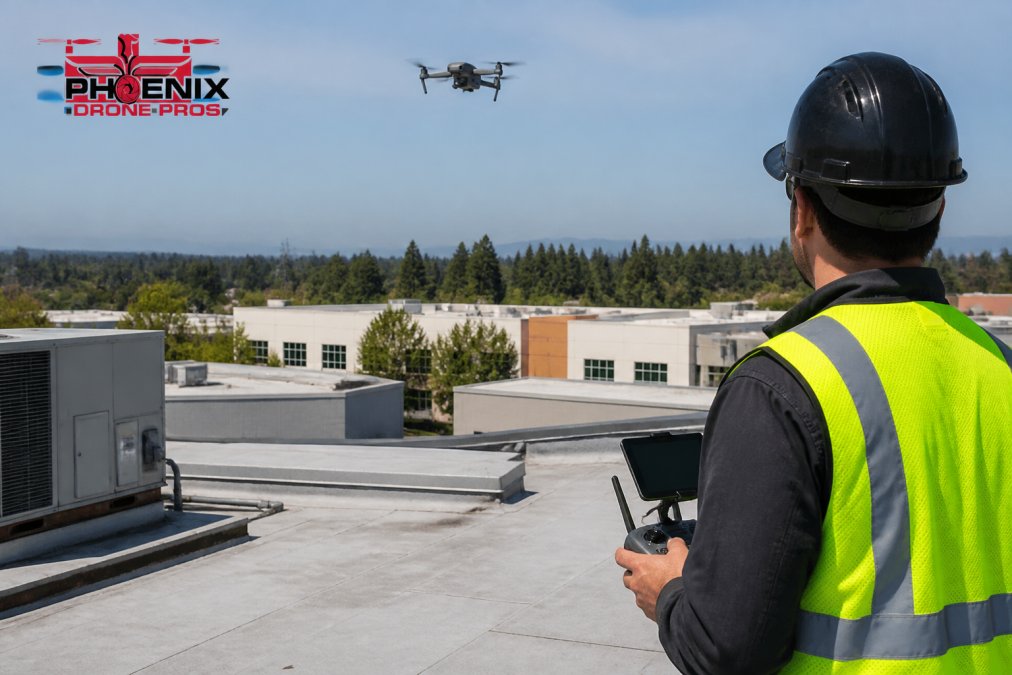
A drone roof inspection is a structured process: plan the flight, capture high-resolution imagery and sensor data, then process it into a report a facility manager can act on. The flight is the short part; planning and data analysis are where the value lives.
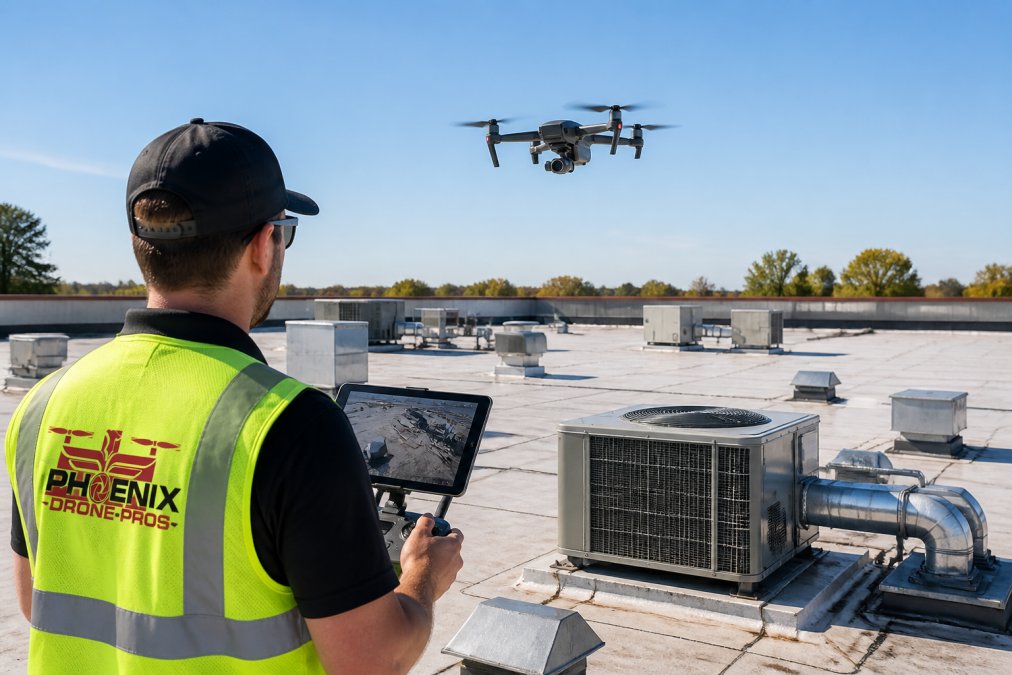
Aerial Data Collection and Photogrammetry
Before launch, the pilot builds a flight plan setting altitude, overlap, and grid pattern. That overlap matters: photogrammetry stitches the images into a single orthomosaic map of the roof, a flat, measurable image you can zoom into and annotate. Overlapping shots also generate a point cloud, a 3D model showing slope, ponding, and equipment placement.
The drone flies a systematic grid, capturing high-resolution imagery of every section. Software assembles the images, and the inspector reviews the result for damage, debris, and drainage problems.
Thermal Imaging for Roof Leaks: Seeing What the Eye Misses
Thermal imaging for roof leaks works because wet insulation holds heat differently than dry material (nist.gov). An infrared sensor detects that temperature difference and reveals moisture that is invisible in a standard photo.
This matters because most roof damage starts below the surface. A small breach lets water into the insulation, where it spreads and degrades the roof from the inside. By the time it shows as a ceiling stain, it is expensive.
Infrared thermography paired with visual imagery lets an inspector map moisture detection across the entire roof and pinpoint where water is entering. That combination of infrared sensors and high-resolution cameras separates a real roof condition assessment from pretty photos. The same thermal drone technology Phoenix Drone Pros uses for inspections also supports search and rescue work in low-visibility conditions.
FAA Part 107 Requirements for Roof Inspections
FAA Part 107 requirements for roof inspections mean the pilot flying over your building must hold a Remote Pilot Certificate. Part 107 governs commercial small drone operations in the United States and applies to anyone flying a drone for business, including roof inspections.
The FAA's official Part 107 overview covers the core rules: the pilot must pass an aeronautical knowledge test, register the aircraft, keep the drone within visual line of sight, and avoid flying over people who are not part of the operation. For commercial work, hiring a certified operator is not optional. It is the baseline for a legal, insured flight.
Credentials matter. A certified, insured operator carries liability coverage and follows safety compliance rules that protect the property owner. Asking for proof of certification and insurance before any flight is a reasonable first step.
Your Commercial Roof Maintenance Checklist After the Flight
The inspection is only useful if it feeds your maintenance process. A commercial roof maintenance checklist turns the flight data into scheduled action.
- Review the orthomosaic map and flag every area of concern
- Cross-reference thermal findings with visual damage
- Prioritize repairs by severity and leak risk
- Log findings in your facility management system with dates and photos
- Schedule preventative repairs before the next storm season
- Set the next inspection interval based on roof age and condition
- File the report for warranty and insurance records
The post-inspection workflow is where most teams drop the ball. A report that sits in an inbox does nothing; one that triggers a work order, a budget line, and a follow-up date protects the asset.
Integrating Drone Data Into Your CMMS
Most guides stop at the inspection. The real leverage is pushing drone findings into the system you already use to run the building. A Computerized Maintenance Management System (CMMS), platforms like Maximo, Fiix, UpKeep, or FacilityONE, is where work orders, asset histories, and budgets live. Drone data becomes valuable when it lands there.
A practical integration workflow:
- Export deliverables in usable formats. Ask the operator for a georeferenced orthomosaic (GeoTIFF), a thermal moisture map, and a findings list in CSV or PDF. Georeferenced files let you overlay findings on a building plan.
- Create a roof asset record. In the CMMS, set up the roof as a tracked asset with its membrane type, install date, warranty expiration, and inspection history.
- Convert findings into work orders. Each flagged defect, a lifted seam, a ponding area, a punctured membrane, becomes a work order with location, photo, and priority. Attach the thermal image so the technician sees the moisture footprint, not just the surface symptom.
- Tag by defect type. Use consistent categories (seam failure, flashing damage, drain blockage, membrane puncture) so you can trend failures over time and spot a recurring problem area.
- Set recurring inspection tasks. Tie the next drone flight to a calendar trigger, pre-storm season, post-storm, or a fixed interval, so it does not depend on someone remembering.
- Feed the capital plan. Aggregate findings by severity to justify roof replacement in next year's budget instead of reacting to a mid-year leak.
If your CMMS does not accept georeferenced files, a shared drive with a naming convention (building, date, sensor type) plus a linked spreadsheet of findings gets most of the benefit. The point is consistency, not sophistication. professional drone imagery.
How Inspection Reports Affect Insurance and Warranty Claims
A dated, sensor-backed inspection report is one of the most useful documents a facility manager can hold.
- Warranty claims. Membrane manufacturers typically require documented maintenance to keep a warranty valid. A drone report with thermal evidence of moisture intrusion, dated before a leak became a claim, shows good-faith maintenance. Without that record, a manufacturer can argue neglect.
- Insurance claims. After a hail or wind event, an adjuster wants to know what the roof looked like before and after. A pre-storm drone inspection establishes a baseline; a post-storm flight documents damage. That before-and-after pair is far more persuasive than a written description.
- Underwriting and premiums. Carriers increasingly look at maintenance history when pricing property coverage. A documented inspection program signals a well-managed asset, which can support better terms at renewal. Underwriting varies by carrier and property, but a maintenance file is a factor you control.
- Liability. If a roof defect leads to interior damage or injury, an inspection record shows when the issue was identified and what action followed. A report that was filed and ignored is worse than no report at all.
Equipment, Sensors, and What Drives Inspection Costs
Pricing depends on roof size and complexity, sensors required, and reporting depth. A single flat roof with a standard visual inspection differs from a multi-building campus needing thermal imaging, 3D mapping, and a detailed report. The honest answer is that pricing depends on scope, and the fastest path is a direct quote.
What separates a useful quote from a vague one is whether the operator can explain which sensor matches your roof assembly. Sensor choice is not interchangeable, it is driven by membrane type, insulation, and what you are trying to detect.
| Sensor Type | What It Detects | Best For | Roof Types Where It Excels |
|---|---|---|---|
| High-resolution RGB camera | Surface damage, debris, seam issues, membrane punctures | Visual documentation and reporting | All membranes; essential baseline for every flight |
| Thermal infrared sensor | Moisture, insulation gaps, heat loss, wet substrate | Leak detection and moisture mapping | EPDM, TPO, modified bitumen, built-up roofs with absorbent insulation |
| LiDAR / point cloud | Surface geometry, slope, ponding, equipment clearance | 3D modeling and drainage analysis | Large flat roofs, ballasted systems, complex HVAC layouts |
| Multispectral | Material and vegetation stress | Specialized assessments | Vegetated and green roofs, reflective coating degradation |
A few practical rules of thumb most experienced operators follow:
- EPDM and TPO membranes are the strongest candidates for thermal imaging. Dark, low-slope membranes with wet insulation underneath show clear thermal contrast during the right conditions, typically a few hours after sunset, when the roof is releasing stored heat and wet areas cool more slowly than dry ones.
- Metal roofs are trickier for thermal because the metal conducts heat so efficiently that surface temperature evens out. RGB imagery and LiDAR often carry more diagnostic weight here, with thermal used mainly to spot fastener back-out and seam separation.
- Ballasted and gravel-surfaced roofs hide damage under the aggregate. LiDAR helps map surface irregularities and ponding, while thermal can still reveal moisture beneath the ballast if the flight is timed correctly.
- Green roofs need multispectral or high-resolution RGB because thermal signatures are dominated by vegetation, not the waterproofing layer beneath.
Payload and flight parameters matter as much as the sensor. A typical inspection drone carries a stabilized RGB camera and a radiometric thermal sensor on a gimbal, flies a grid at a fixed altitude with 70-80% image overlap, and captures data at a resolution fine enough to resolve a seam or a blister. Lower altitude means more detail but more flight time and more images to process. Higher altitude covers more roof per pass but can miss small defects. The operator should be able to tell you the ground sampling distance, the real-world size of one pixel, they plan to deliver.
Cost drivers, in rough order of impact:
- Roof area and complexity. Square footage sets flight time; HVAC units, skylights, and parapets add passes and processing.
- Sensor payload. RGB-only flights are the least expensive. Adding thermal, LiDAR, or multispectral raises equipment cost and processing time.
- Deliverable depth. Raw imagery is cheapest. An orthomosaic map, thermal moisture map, annotated findings, and a written report cost more because an analyst has to build them.
- Access and logistics. Urban high-rises, restricted airspace, and buildings requiring coordination with tenants add planning time.
- Frequency. A recurring maintenance contract usually lowers the per-inspection price compared to one-off flights.
A DIY approach, buying a drone and learning to fly it, only makes sense if you inspect frequently and have time to master flight planning software and data analytics. For most facility managers, outsourcing to a certified operator wins: professional-grade sensors, processed deliverables, and an actionable report without building an in-house program.
The DIY-versus-outsourcing decision comes down to volume. If you manage one or two roofs, outsourcing wins on cost and quality. If you run a large portfolio and inspect monthly, an in-house program can eventually pay off, but only after investing in training, equipment, and processing software.
A cheap drone flight is not the same as an inspection. Operators who deliver raw footage with no thermal data, no measurements, and no report leave you guessing. Insist on processed deliverables: an orthomosaic map, thermal findings, and a written summary of what needs fixing.
For teams that want the full package, Phoenix Drone Pros handles thermal roof inspections and construction progress documentation, with local pilots available in Phoenix and San Antonio.
Frequently Asked Questions
How much does a drone roof inspection cost?
Pricing depends on roof size, building height, number of structures, and the sensor package you need. A single flat commercial roof with standard high-resolution imagery costs less than a multi-building campus requiring thermal imaging and 3D mapping. Most providers quote per project rather than per square foot. Contact Phoenix Drone Pros directly for a quote tailored to your property.
Do drone operators need FAA certification for commercial roof inspections?
Yes. Any drone flight conducted for business purposes, including commercial roof maintenance inspections, falls under FAA Part 107 rules. The remote pilot must hold a current Part 107 certificate, pass a knowledge test, and follow airspace restrictions. Hiring an uncertified operator exposes property managers to liability if an incident occurs. Always verify certification and insurance before booking.
Can drones detect water leaks in commercial roofing?
Yes. Thermal imaging for roof leaks uses infrared sensors to spot temperature differences caused by trapped moisture. Wet insulation cools differently than dry material, so the camera reveals saturated areas that look normal to the naked eye. Pairing thermal data with high-resolution imagery and photogrammetry lets inspectors pinpoint leak sources before they spread and damage structural integrity.
How often should commercial roofs be inspected using drone technology?
Most commercial roofing systems benefit from a drone inspection twice a year, plus after any major storm. Flat roofs and older membranes may need quarterly checks. A consistent commercial roof maintenance checklist, covering drainage, seams, flashing, and HVAC penetrations, helps you catch small issues before they become expensive preventative repairs and extends the roof lifecycle.
Managing a commercial roof means deciding where to spend limited maintenance budget, and guessing rarely works. Phoenix Drone Pros brings FAA-certified pilots, full insurance, and over a decade of commercial drone experience to every flight, delivering detailed thermal and visual data you can turn into a real maintenance plan. Get started with Phoenix Drone Pros and schedule an inspection that protects your roof before the next leak finds you.