 blog
blog
Drone Roof Inspection: Documentation vs Aerial Footage
Table of Contents
- Why Drone Roof Inspection Deliverables Get Confused
- Reliable Construction Progress Documentation vs Stunning Aerial Footage
- What a Drone Roof Inspection Report Should Contain
- Drone Roof Inspection vs Manual Roof Inspection: Safety, Speed, and Coverage
- Repeatable Capture Standards Across Inspection Dates
- When Aerial Footage Is Not Enough for Roof Diagnosis
- Choosing Deliverables by Stakeholder and Decision
- Frequently Asked Questions
Last Updated: October 8, 2026
Why Drone Roof Inspection Deliverables Get Confused
A drone roof inspection gives you two very different products, and most buyers never separate them until the invoice arrives: a record you can defend in a meeting, and footage that makes a listing look good.
Both come from the same flight. That is exactly why they get mixed up.
At Phoenix Drone Pros, we shoot both every week, and the confusion costs clients real money. A property manager orders "drone photos," receives cinematic footage, then discovers nobody can tell whether the HVAC curb flashed correctly in March.
Below, we break down what separates reliable construction progress documentation from stunning aerial footage, and how to order the right one for your roof.
Reliable Construction Progress Documentation vs Stunning Aerial Footage
These are not competing products but two outputs from one flight, built to different standards. Knowing which standard applies to your roof is the whole game.
What Inspection-Grade Documentation Includes
A drone roof inspection report is a measured visual record of roof condition at a point in time. It answers: what changed, where, and when.
Inspection-grade work typically includes:
- High-resolution still images of every roof plane
- Fixed camera angles repeated on each visit
- Roof measurements and area calculations
- Annotated images marking defects, damage, or completed work
- Field notes tied to specific image numbers
- A written summary that stands alone without the images
The point is traceability. If a contractor claims a repair was finished, the image either shows it or it does not.
What Stunning Aerial Footage Delivers
Aerial footage is built to persuade. It sells a property, opens a pitch deck, or shows a client the scale of a site.
Typical footage work includes:
- Smooth orbit and reveal shots around the structure
- Golden-hour lighting for warmth and depth
- Edited sequences with music and titles
- Before-and-after comparison edits for marketing
- Short clips sized for listings and social media
None of that is wrong. It is just a different job. A beautiful orbit shot tells you nothing about whether a roof drain is blocked.
What a Drone Roof Inspection Report Should Contain
A useful drone roof inspection report is a decision document, not a photo dump. If you cannot hand it to an adjuster, a board, or a contractor and get a clear answer, it is incomplete, and acceptance usually comes down to inspection-grade capture and traceability.
Inspection-Grade Capture Standards
Inspection-grade imagery is not just "high resolution", it is captured to a repeatable specification so two flights, months apart, can be compared pixel to pixel. This baseline works:
- Ground sample distance (GSD): roughly 0.3 to 0.5 cm per pixel at the roof surface. Coarser than that and hairline cracks, lifted flashing edges, and sealant failures blur into noise.
- Image overlap: 70 to 80 percent forward and 60 to 70 percent side overlap when flying a grid, so every roof plane appears in multiple frames.
- Camera angle: nadir (straight down) for measurement and orthomosaics, plus 30 to 45 degree oblique passes for flashing, parapets, and vertical surfaces.
- Lighting: overcast or high-sun-angle flights to reduce hard shadows, at a consistent time of day across visits.
- Geotags and timestamps: every image carries GPS coordinates and a capture time, which is what makes the record defensible later.
Measurable Documentation KPIs
You can grade a report before you accept it:
- Roof-area coverage: what percentage of the roof surface appears in at least one usable frame. Aim for full coverage of every plane.
- Defect localization: each finding tied to a specific image number and a location on the roof (plane, edge, penetration, drain).
- Capture completeness: every roof section, penetration, and edge condition photographed.
- Time from flight to report: how long between capture and a deliverable you can act on.
- Repeatability score: how closely this flight's path, altitude, and angles match the previous visit.
Evidence Traceability and Audit-Ready Records
A report that cannot be traced can be challenged. Audit-ready records include:
- Original, unedited image files with embedded GPS and timestamp metadata
- A file-naming convention tied to date, site, and roof section
- Annotated images marking each defect, tied to the written finding
- A change log showing what was added, corrected, or superseded between versions
- A written summary that stands alone without the images
That traceability lets one package support an insurance claim, a contractor handoff, or a dispute over completed work. Edited video rarely carries any of it.
A Complete Report Usually Holds
- A site summary with date, time, and weather conditions
- Full coverage imagery of every roof section
- Annotated images for each defect found
- Roof measurements and, where needed, an orthomosaic
- Field notes matched to image numbers
- A clear list of findings, ranked by urgency
Check any report before you accept it:
- Every roof plane appears in at least one image
- Each defect has a close-up and a wider context shot
- Image file names or numbers match the written findings
- Dates, times, and conditions are recorded
- Original files with metadata are included, not just edited exports
- The summary makes sense without the photos
If a report fails two or more of these, ask for a re-flight or a corrected version.
Drone Roof Inspection vs Manual Roof Inspection: Safety, Speed, and Coverage
The drone wins on safety and speed, and it is not a close call.
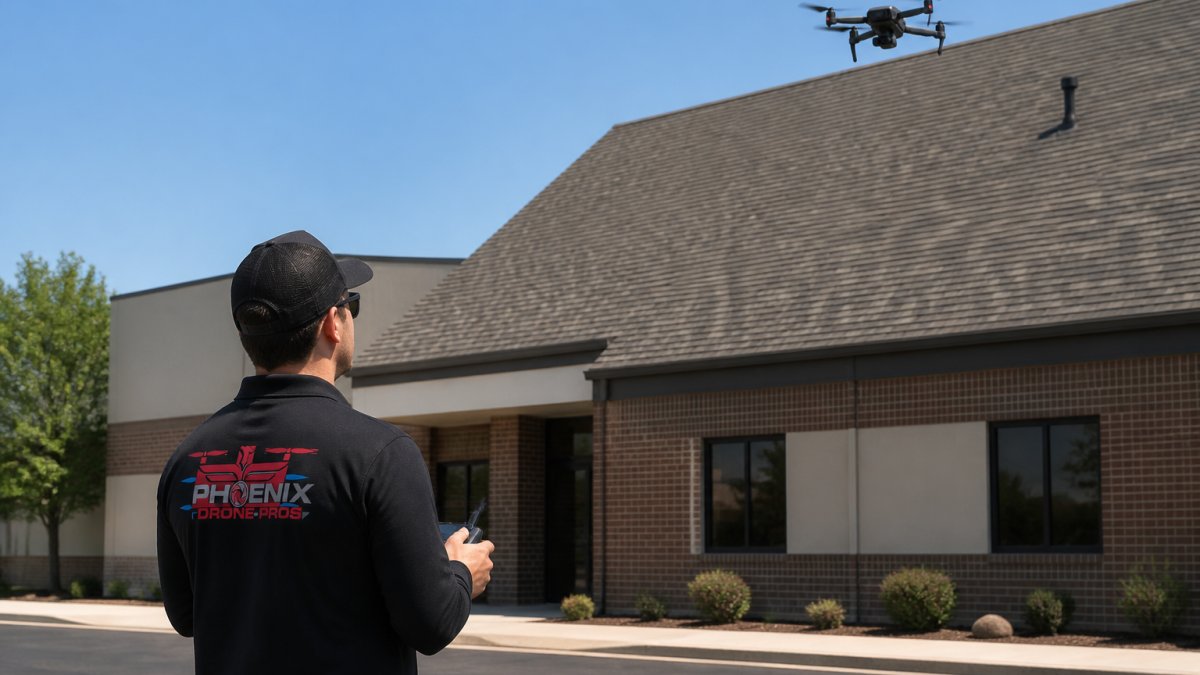
Manual inspection means someone climbs a ladder, walks a pitched surface, and leans over an edge.
A drone keeps both feet on the ground, reaching steep roofs, tall commercial buildings, and areas that would otherwise require lifts or rope access.
Coverage improves too. A person on a roof sees one section at a time; a drone captures the whole roof in a single pass, making before-and-after comparison far easier.
| Factor | Drone Roof Inspection | Manual Roof Inspection |
|---|---|---|
| Safety | No roof access needed | Fall risk for the inspector |
| Speed | Fast, whole-roof coverage | Slower, section by section |
| Access | Steep and high roofs included | Limited by pitch and height |
| Documentation | Repeatable, geotagged images | Notes and handheld photos |
| Best for | Condition records, progress, claims | Close tactile checks, repairs |
One honest limit: a drone cannot feel a soft spot or test a seal by hand. For a hands-on repair diagnosis, you still need someone on the roof.
Repeatable Capture Standards Across Inspection Dates
Repeatable capture turns a pile of drone photos into a progress record. When every flight uses the same flight path, altitude, camera angle, and image overlap, the images stack into a timeline you can compare. Consistent visual data provides the foundation for drone home inspections to identify structural vulnerabilities before they escalate into costly repairs.
A repeatable standard usually fixes:
- Flight path and altitude for each roof section
- Camera angle and image overlap between shots
- Time of day to control shadows
- Reference points that appear in every visit
- File naming tied to date and location
When those stay constant, before-and-after comparison is trivial: open two dates side by side and see what changed. When they drift, you get pretty pictures that do not line up. This is the difference between footage that impresses and documentation that holds up.
When Aerial Footage Is Not Enough for Roof Diagnosis
Aerial imagery shows surface condition well but struggles with what sits underneath, plus capture conditions even a well-flown mission cannot overcome. Knowing those limits separates an operator who documents from one who diagnoses.
Where Aerial Imagery Hits Its Ceiling
Hidden moisture and subsurface damage. A drone sees the top surface only.
Glare and reflectivity. Standing-seam metal, modified bitumen, and wet membrane roofs throw specular reflections that can wash out entire roof planes in a single frame, hiding defects even at high resolution.
Hard shadows. Parapets, HVAC units, penthouses, and tall roof penetrations cast shadows that hide the surface immediately adjacent to them.
Interior water damage with no visible exterior cause. When a ceiling stain is the first symptom, the drone may find nothing on the roof surface.
Structural concerns that need a physical probe. Sagging decking, compromised trusses, and fastener failures cannot be confirmed from the air. They need hands, tools, or sensors on the roof.
What Resolves the Gap
For the cases above, a drone is the first step, not the last. It narrows the search and documents what is visible; then a qualified roofer or engineer takes over, typically with:
- Infrared thermography to reveal moisture trapped below the surface as temperature differentials
- Moisture meters to confirm readings at suspect locations
- Physical probes and core samples to verify deck and insulation condition
- Close-up or hands-on inspection of flashing, penetrations, and edge conditions
How to Sequence the Work
The efficient pattern is: fly first to map the roof and flag suspect areas, then send a person up only to the flagged locations. That reduces roof time, reduces fall exposure, and keeps the drone imagery as the record of what was found and where. The drone does not replace the roofer. It tells the roofer exactly where to look.
Choosing Deliverables by Stakeholder and Decision
The right deliverable depends on who is reading it and what they must decide.
- Insurance adjuster: inspection-grade stills, dates, measurements, annotated defects
- Property manager: condition report with ranked findings and repeatable capture
- Real estate agent: polished aerial footage and stills for the listing
- Construction project manager: dated progress documentation and before-and-after comparison
- Facility team: aerial assessment to plan maintenance and site work
Map the deliverable to the decision. An adjuster needs evidence. A buyer needs a feeling. A project manager needs a timeline.
At Phoenix Drone Pros, every job starts with one question: what decision does this flight need to support? For teams that want to bring capture in-house, we also offer Done flight training to get your own pilots flying to a repeatable standard.
Roof decisions rarely wait, and the wrong deliverable can cost you a claim, a deadline, or a deal. Phoenix Drone Pros delivers both sides of the job: inspection-grade drone roof inspection reports with repeatable capture, measurements, and annotated findings, plus stunning aerial footage for listings and marketing.
Frequently Asked Questions
What should a drone roof inspection report include?
A useful drone roof inspection report pairs high-resolution imagery with annotated defect notes, roof measurements, and coverage documentation for every slope. It should identify damage locations, flag areas needing closer review, and include flight metadata so the record can be verified later. Reports built only from video clips rarely hold up when an insurer, adjuster, or property owner asks for specifics about a single section of the roof.
Are drone roof inspections as reliable as manual inspections?
For visual condition assessment, drone roof inspection matches manual inspection across most roof types, and it removes fall risk for steep or fragile roofs. A drone captures consistent angles and full coverage that a person on a ladder often cannot. Manual inspection still wins when someone needs to physically probe a membrane, check attic-side moisture, or confirm structural movement that only shows up close.
Can drone footage document construction progress over time?
Yes, when the capture is planned for it. Construction progress documentation works best with fixed flight paths, consistent altitudes, and matching camera angles on each visit. That lets you stack images from week to week for before-and-after comparison, track issue resolution, and hand a project timeline to owners or lenders without re-shooting from scratch.
When is a manual roof inspection still necessary?
A manual roof inspection is still needed when the question is about material condition rather than visual appearance. If a drone image shows a suspicious patch, someone has to get on the roof to test the membrane, check for soft spots, or verify flashing details. Drone roof inspection tells you where to look; it does not replace hands-on confirmation for structural or material diagnosis.