 ultimate-guide
Start a Drone Roof Inspection Business: 2026 Guide
Table of Contents
- What You Need to Start a Drone Roof Inspection Business
- FAA Part 107 Certification Requirements for Commercial Operators
- Essential Equipment and Hardware for Roof Inspections
- How to Price Drone Roof Inspections and Build Your Rate Card
- Insurance and Liability Coverage for Drone Roof Inspection Services
- Drone Roof Inspection Report Templates and Data Delivery
- Marketing Your Drone Inspection Services to Build Client Relationships
- Conclusion
- Frequently Asked Questions
Last Updated: September 20, 2026
What You Need to Start a Drone Roof Inspection Business
Starting a drone roof inspection business requires FAA certification, equipment, insurance, and operational rigor. The barrier to entry is low, but profitability demands treating the business side as seriously as the flying side. You'll need Part 107 certification, liability insurance, proper pricing strategy, and a repeatable workflow that turns raw footage into actionable client deliverables.
FAA Part 107 Certification Requirements for Commercial Operators
To legally operate a drone commercially, you must hold an FAA Part 107 remote pilot certificate. Flying without it exposes you to federal fines up to $27,500 and criminal liability. The certification process involves passing a written exam covering airspace rules, weather, safety, and regulations (study time: 20-40 hours; exam cost: $175). The exam covers visual line of sight requirements, altitude restrictions, and LAANC (Low Altitude Authorization and Notification Capability) airspace authorization. The FAA requires recurrent training every two years to maintain your certificate. Consider accredited drone flight training if you're new to operations, this builds muscle memory and safety discipline before managing client expectations.
Essential Equipment and Hardware for Roof Inspections
Your equipment investment determines deliverable quality and operational capability. Cutting corners means missing defects your clients expect you to catch.
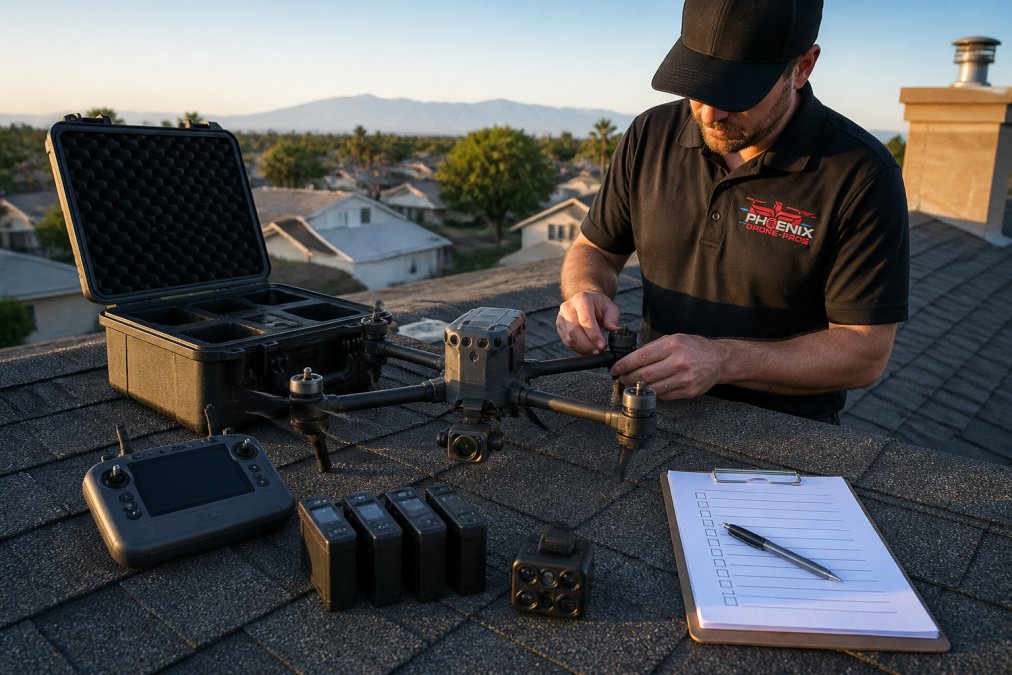
Drone Selection and Specifications
For roof inspections, you need a platform that carries a thermal camera, delivers stable footage, and handles wind conditions common on rooftops. Key specifications: flight time (30+ minutes), wind resistance (25+ mph gusts), payload capacity for thermal sensors, and obstacle avoidance. A 30+ minute flight time lets you complete most residential inspections on a single battery, increasing client confidence and reducing labor costs.
Thermal Imaging and Sensor Technology
Thermal imaging separates a basic aerial photo service from a genuine inspection business. A thermal camera captures infrared data showing temperature variations across the roof surface, revealing structural issues that standard RGB photography misses. Sensor calibration is critical, uncalibrated thermal data is useless for client reporting. Before each inspection, verify your thermal sensor is properly calibrated and your drone's gimbal is level (5-10 minutes). This prevents inaccurate reports that expose you to liability.
How to Price Drone Roof Inspections and Build Your Rate Card
Pricing is where most new operators leave money on the table. Understand your true cost of delivery, then build a rate card that covers those costs plus margin.
Understanding Your Equipment Investment and ROI
Entry-level setup (suitable for residential inspections, basic thermal analysis):
- Drone platform: $2,500-$4,000
- Thermal camera: $1,500-$3,000
- Batteries (3-4 spares): $600-$1,000
- Spare parts, propellers, ND filters: $400-$600
- Software licenses: $50-$150/month
- Total initial outlay: $5,000-$8,600
Professional-grade setup (commercial properties, orthomosaic mapping, structural analysis):
- Drone platform: $5,000-$8,000
- Thermal camera (high-resolution, radiometric): $3,000-$6,000
- RGB camera upgrade: $1,500-$3,000
- Batteries (4-6 spares): $1,200-$2,000
- Spare parts, maintenance reserves: $800-$1,200
- Software licenses: $100-$300/month
- Total initial outlay: $11,500-$20,200
To calculate ROI, divide your total equipment cost by your average revenue per inspection. A $7,000 entry-level investment breaks even after 18 inspections at $400/job, or 12 jobs at $600/job. Pricing directly affects capital recovery speed.
Building Your Cost-Based Rate Card
Your rate card should reflect three cost categories: equipment depreciation, labor, and overhead. A $7,000 entry-level setup depreciates at $1,400-$2,300 per year ($6-$13 per inspection across 15-20 jobs monthly). A residential inspection requires 2-3 hours of billable time (site assessment, pre-flight checks, flight, data processing, report generation). At $50-$75/hour, that's $100-$225 in labor cost. Monthly overhead (insurance, vehicle, software, licensing, marketing) totals $450-$1,150, or $23-$77 per inspection. Total cost per residential inspection: $130-$315. Price at least 2.5-3x your cost to ensure margin for unexpected expenses and equipment replacement.
Pricing Models and Tiered Service Offerings
Break your service into tiers:
Basic Inspection ($300-$450): Aerial photographs (RGB only), visual damage assessment, written summary, PDF delivery.
Standard Inspection ($500-$750): Aerial photographs, thermal imaging with annotated problem areas, detailed findings report organized by roof section, priority-level recommendations, PDF and cloud-based access.
Add-on services:
- Thermal analysis report only: $150-$250
- Orthomosaic mapping: $200-$400
- 3D reconstruction: $300-$600
- Rush processing (24-hour turnaround): +25-50% of base price
- Multi-property discounts: 10-15% off per additional property
Market Rate Benchmarking
Residential roof inspections in most markets range from $300-$600; commercial inspections range from $800-$2,500+. Don't compete on price alone. Compete on speed (24-hour reports), quality (high-resolution thermal data), or specialization (insurance claims, solar assessments). These justify higher rates and attract clients who value results over cost.
Adjusting Rates as You Scale
Increase your rates 10-15% annually as your efficiency and reputation grow. A $400 inspection in year one becomes $500+ by year three, dramatically improving profitability without requiring more volume.
Insurance and Liability Coverage for Drone Roof Inspection Services
Liability insurance is mandatory. A single accident can bankrupt an uninsured operator. Drone-specific insurance covers aircraft liability, property damage, and bodily injury, with minimum coverage of $1 million. Your insurance provider will ask about drone types, services offered, safety protocols, and experience level. Thermal roof inspections are lower-risk than autonomous flights, so premiums tend to be reasonable.
Drone Roof Inspection Report Templates and Data Delivery
Your report is the deliverable that justifies your price. Professional reporting makes you look like an inspector with specialized tools.
Building Your Report Template and Structure
A strong inspection report includes: high-resolution aerial photographs, thermal imaging analysis with annotated problem areas, findings organized by roof section, recommended repairs with priority levels, and specific location references. Your template should include: cover page (branding, client name, property address, inspection date, weather, drone/camera specs), executive summary, findings by section (aerial photo, thermal overlay, issues, recommended action), priority matrix (Immediate Attention Required, Monitor, Good Condition), recommended repairs, thermal data appendix, and contact information.
Post-Inspection Workflow Automation: The Efficiency Multiplier
Raw drone footage and thermal data aren't client-ready. You need a workflow that processes orthomosaic imagery, aligns thermal data with RGB photography, and produces final reports with minimal manual intervention. Manual workflow: Flight → Download → Import → Wait for rendering (2-4 hours) → Manually annotate → Open template → Copy-paste → Format PDF → Email. Total: 4-6 hours.
Key automation tools:
- Cloud processing platforms (WebODM, Pix4D, DroneDeploy): Upload raw footage for automated orthomosaic generation, 3D modeling, and thermal processing. Pix4D and DroneDeploy integrate with APIs for batch processing. Thermal analysis plugins: Tools like FLIR Thermal Studio automatically detect temperature anomalies and flag problem zones, saving 30-45 minutes per inspection. Report generation automation: Use templating software (Zapier, Make, or custom scripts) to auto-populate your report template with inspection metadata, thermal findings, and client information from your CRM, reducing report generation from 45 minutes to 10 minutes. CRM integration: Connect your drone workflow to your CRM so completed inspections automatically log findings, trigger follow-up emails, and update client records. Batch processing: Process multiple inspections in parallel, while cloud software renders orthomosaics for Jobs A and B, you're flying Job C.
Data Delivery and Client Integration
Clarify delivery expectations before the flight. Homeowners need PDF reports within 24-48 hours. Property managers need cloud-based portal access for thermal imagery, raw data, and historical inspections. Insurance companies need integration with their claims management system. Solar installers need georeferenced orthomosaic maps and 3D roof models compatible with solar design software.
Structuring Your Workflow for Scale
As you grow from 2-3 inspections per week to 10+, manual workflows collapse. Build your process to scale:
- Standardize flight patterns: Use the same flight path, altitude, and camera settings for every residential inspection.
- Create inspection checklists: Document pre-flight checks, flight parameters, and post-flight data handling.
- Automate data ingestion: Use cloud storage with automatic folder structures to trigger processing immediately.
- Set processing priorities: Configure your cloud processing service to prioritize urgent jobs over routine inspections.
- Build a findings library: Create a database of common roof issues to auto-tag findings in reports.
- Implement quality checks: Before sending a report, verify all findings are annotated, thermal scale is correct, and recommendations are clear.
Managing Raw Data and Client Access
Decide upfront how long you'll retain raw thermal and RGB data. Most operators keep data for 1-2 years, then archive or delete. Communicate this in your service agreement.
Marketing Your Drone Inspection Services to Build Client Relationships
The most effective channel for drone roof inspection services is direct outreach to property managers, real estate agents, and insurance companies. These are repeat customers who send ongoing work. One property management company managing 50 buildings is worth more than 50 one-time homeowners.
Conclusion
Building a profitable drone roof inspection business requires mastering three disciplines: the technical flying skills to capture quality data, the operational discipline to deliver consistent reports, and the business discipline to price properly and market effectively. The barrier to entry is low, you can start with Part 107 certification and a quality drone.
Frequently Asked Questions
Do I need a license to fly a drone for roof inspections?
Yes. The FAA requires all commercial drone operators to hold a Part 107 Remote Pilot Certificate. This involves passing a written exam and demonstrating knowledge of airspace regulations, safety protocols, and operational limitations. You cannot legally conduct roof inspections for compensation without this certification. The exam covers topics like visual line of sight requirements, airspace authorization through LAANC, and pre-flight planning procedures.
What insurance coverage is required for drone roof inspection businesses?
Commercial drone operators need liability insurance that covers property damage and bodily injury. Most insurers require a minimum of $1 million in general liability coverage. Your policy should specifically cover aerial operations and drone-related incidents. Additionally, consider equipment insurance for your drone hardware. Your insurance provider can help determine the right coverage limits based on your service area and client base.
How much does a drone roof inspection cost for customers?
Pricing varies based on property size, roof complexity, inspection type, and your location. Factors affecting cost include travel distance, number of properties, whether thermal imaging is needed, and report complexity. For accurate pricing tailored to your market, contact Phoenix Drone Pros for a custom quote.
What equipment is most important for starting a drone roof inspection business?
Your core equipment includes a commercial-grade drone capable of stable flight and high-resolution imagery, a remote pilot controller, multiple batteries for extended flight time, and thermal imaging sensors for detecting moisture and structural issues. You'll also need a laptop for data processing, cloud storage for client files, and flight planning software for pre-flight checklists and airspace authorization. Invest in quality hardware that provides reliable performance and professional-grade output.