 how-to
Why Drone Site Safety Monitoring Is Essential Today
Quick Summary
Drone site safety monitoring uses unmanned aerial systems to capture regular aerial photos and video of a worksite, letting safety teams spot hazards and inspect high areas without putting workers at risk. It gives safety managers a full view of a changing site, faster than a ground walk-through alone.
- Drones capture the full site from above, including roofs, edges, and upper levels
- Fly the site before the morning crew arrives to catch hazards early
- Keep flight paths consistent so weekly images can be compared
- Assign a pilot, a safety reviewer, and a foreman with clear responsibilities
- Require ground verification of every flagged hazard before closing it
Table of Contents
- What Drone Site Safety Monitoring Actually Does
- Spotting Hazards Before Workers Reach Them
- Inspecting High and Hard-to-Reach Areas Without Exposing Crews
- Tracking Progress and Site Activity Week to Week
- Building Drone Mapping Into Your Safety Routine
- Limits, Risks and Rules to Plan Around
- Using a Drone Safety Inspection Checklist on Your Next Job
- Frequently Asked Questions
What Drone Site Safety Monitoring Actually Does
Last Updated: November 1, 2026
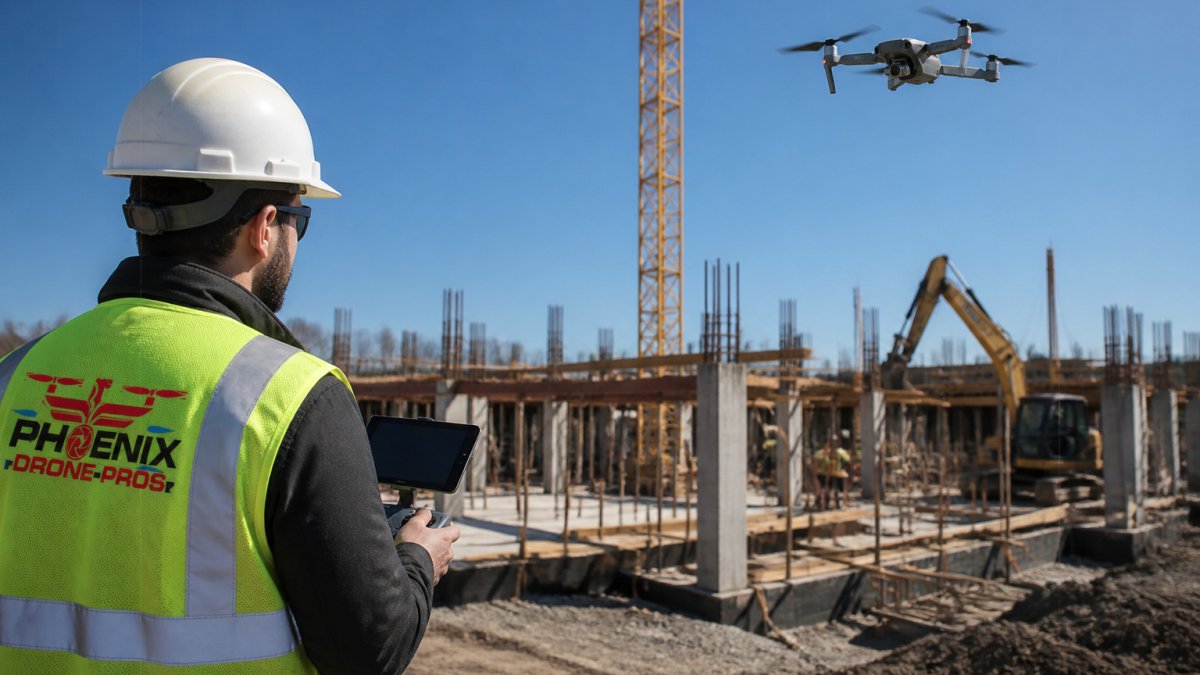
Construction sites are dangerous places, and the people who run them know it. A drone flying over a job site gives a safety manager a view that no single walk-through can match. It sees the whole site at once, from above, and it can reach areas that workers should not enter. That is the core idea behind drone site safety monitoring, and it is why many teams are starting to rely on it. At Phoenix Drone Pros, we see it as a practical tool, not a gimmick.
Drone site safety monitoring means using an unmanned aerial system to collect visual data about a worksite on a regular basis. The drone captures photos and video, and the safety team reviews that footage to spot problems. Researchers writing in Scientific Reports, 2025 describe this approach as a way to collect continuous visual data at real construction sites.
The job is not to replace the safety officer. It is to give that person better information, faster.
- Captures aerial photos and video of the full site
- Reaches roofs, edges, and upper levels without a person climbing
- Creates a visual record that can be reviewed later
- Helps crews see hazards that are hard to spot from ground level
Spotting Hazards Before Workers Reach Them
Hazard spotting is where most teams feel the benefit first. Open trenches, unstable stacks of material, blocked exits, and equipment left in the wrong place are easier to see from the air. A drone can cover a large site in minutes, which means hazards can be found before a crew walks into them.
A review of unmanned aerial systems in safety work notes that drones can move faster than people and reach areas that are hard to access. Those two traits matter most when a site changes daily. A review of unmanned aerial systems and deep learning reports that these capabilities can help safety managers keep pace with changing conditions.
Here is a simple way to use aerial checks for hazard spotting:
- Fly the site before the morning crew arrives
- Look for open edges, unsecured loads, and standing water
- Compare each flight to the previous one to catch new problems
- Share flagged images with the foreman before work starts
Inspecting High and Hard-to-Reach Areas Without Exposing Crews
Some of the most dangerous work on a site happens at height. Roof edges, steel framing, and the tops of tall walls all put workers at risk of falls. A drone lets a safety team look at these areas without sending a person up to check them first.
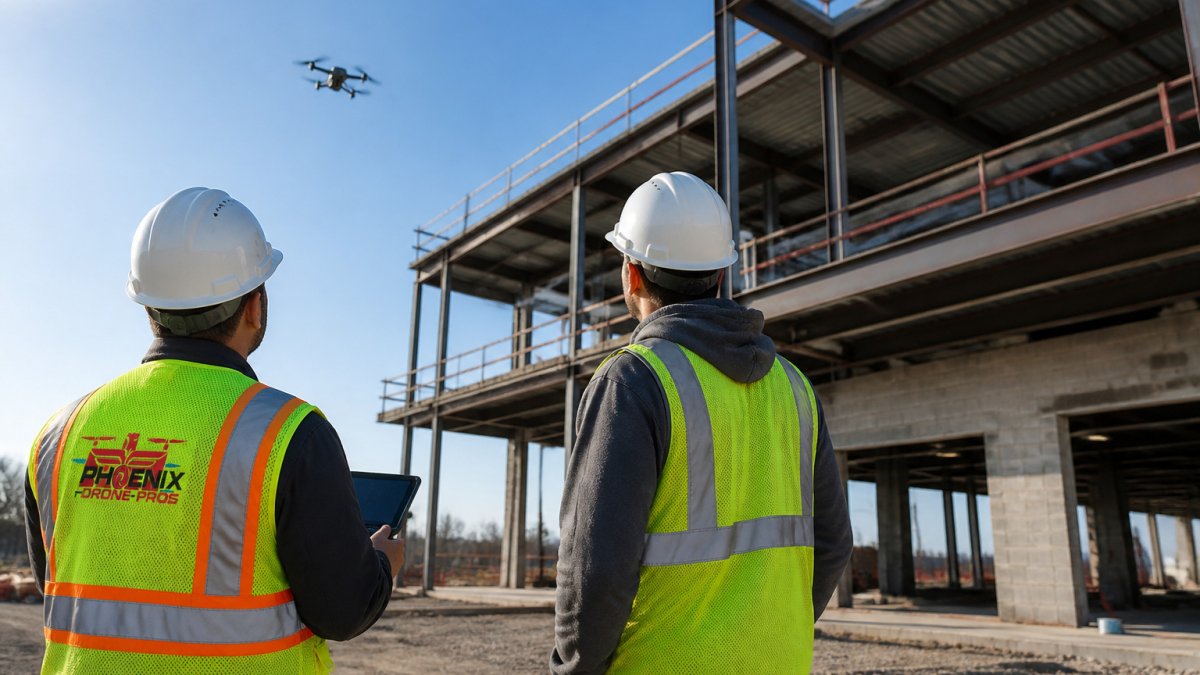
The UAV Coach guide on drone inspections explains that drones can inspect high-risk areas such as unstable structures or tall buildings without placing workers there. That is a useful principle for any site: if a drone can do the look, a crew does not need to make the climb.
Aerial inspection can support roof and elevated checks on commercial properties. A safe inspection starts with the view, and the view should come from the air.
Tracking Progress and Site Activity Week to Week
Safety does not stop after the first walk-through. Sites change every week, and a drone flight every week creates a visual record of how the work moved, where crews were active, and what changed. Those records help teams catch patterns that a single visit would miss.
Consistent flights also support progress tracking. When you compare images from one week to the next, you can see where materials arrived, where work slowed down, and where new risks appeared. Phoenix Drone Pros can support this kind of ongoing documentation with aerial imagery, and reliable construction progress documentation is one of its core services.
Keeping the records useful takes a little discipline:
- Fly from the same spots and at the same height each time
- Label each flight with the date and the work phase
- Store the images where the whole team can find them
- Note any hazard you flagged and whether it was fixed
Building Drone Mapping Into Your Safety Routine
Drone monitoring works best when it becomes part of a routine, not an occasional event. The difference between the two is rarely the drone, it is whether the team has a repeatable workflow for planning flights, reviewing what the drone sees, and closing out the hazards it finds.
A practical routine has four stages. Skipping any one of them is the most common reason a drone program stalls.
1. Plan the flight around the work, not the calendar. Before each flight, the safety lead and the superintendent agree on what the flight is for that week: a pre-shift sweep of open edges, a check on a specific trade's staging area, or a progress capture for the owner.
2. Assign clear roles. A drone program needs three named responsibilities, even if one person wears two hats: a pilot responsible for the flight itself, a safety reviewer who owns the footage review and hazard log, and a superintendent or foreman who owns corrective actions on the ground.
3. Review footage on a fixed schedule. The safety reviewer reviews the flight the same day, tags each finding by location and hazard type, and enters it into the site safety log or corrective-action tracker.
4. Close the loop and feed the next flight. The next flight's plan should start from the previous flight's open items. If a trench edge was flagged last week, the pilot flies that area first this week and the reviewer confirms whether it was corrected.
A sample weekly cadence for a mid-sized commercial project:
- Monday, pre-shift: full-site flight before crews arrive; reviewer posts flagged images to the foreman by mid-morning.
- Wednesday: targeted flight over any area with open corrective actions from Monday.
- Friday: progress capture flight for project records and owner reporting; reviewer closes out the week's hazard log.
- Monthly: safety lead reviews the hazard log for trends, repeat findings, areas with recurring issues, and average time from detection to closure.
Phoenix Drone Pros offers done flight training for teams that want their own staff to fly.
The article lays out a four-stage routine and a sample weekly cadence that teams can follow.
| Day | Flight focus | Who acts |
|---|---|---|
| Monday, pre-shift | Full-site flight before crews arrive | Reviewer posts flagged images to foreman |
| Wednesday | Targeted flight over open corrective actions | Reviewer confirms fixes |
| Friday | Progress capture for records and owner reporting | Reviewer closes out hazard log |
| Monthly | Trend review of hazard log | Safety lead |
Limits, Risks and Rules to Plan Around
Drone monitoring does not remove the need to operate safely. It adds its own risks, and it must follow aviation rules. Commercial drone flights in the United States are governed by the Federal Aviation Administration's Part 107 rules, which apply to construction sites as well.
Drone-introduced safety risks. A drone over an active site is itself a hazard. The controls that matter most:
- Collision and distraction: keep the flight path clear of crane swing radii, power lines, and active work zones. Brief crews on flight times so they are not surprised by a drone overhead while operating equipment.
- Falling objects: pre-flight check props, batteries, and payload attachments; do not fly over workers when the mission can be flown over unoccupied areas.
- Battery and weather: plan for reserve battery capacity, and set a wind and precipitation threshold above which flights are cancelled. A drone that loses power over a crew is a serious event.
- Distraction on the ground: the visual observer and pilot should be focused on the flight, not doubling as safety walkers.
Privacy and worker consent. Aerial cameras capture workers, neighboring properties, and sometimes public areas. Before the first flight, tell the crew what will be captured, who reviews it, and how long it is kept. Many contractors put a short drone-monitoring notice in the site orientation and post signage at the gate. Point the camera at the work, not at break areas or adjacent private property, and avoid capturing identifiable images of the public where the mission does not require it.
Data retention and access. Decide up front how long imagery is kept, who can access it, and how it is stored. A common pattern is to keep raw flight imagery for the project duration plus the period required by the owner or insurer, then archive or delete it. Restrict access to the safety lead, project manager, and owner's rep, and keep the hazard log separate from marketing use of the imagery.
Data quality limits. A photo can miss a hazard that is under a tarp, behind a wall, or hidden by dust. Low light, glare, and wind blur reduce resolution. A drone check should support a ground inspection, not replace it. Build a human verification step into the workflow: every flagged hazard gets a ground confirmation before it is closed.
Keep these points in mind before you fly:
- Confirm the flight is allowed for your site and location, including any airspace authorization
- Plan the route around people, cranes, and power lines
- Brief the crew on privacy, timing, and what the imagery will be used for
- Set a written data-retention and access policy before the first flight
- Check image quality, since poor light or weather can hide problems
- Require ground verification of every flagged hazard before closure
Using a Drone Safety Inspection Checklist on Your Next Job
A written checklist keeps each flight consistent. Use the same list every time so that results from one week can be compared with the next. The list below is a starting point, and you can adjust it for your site.
- Confirm the flight plan and airspace are approved
- Brief the crew on the flight area and timing
- Check for open edges, floor openings, and unprotected drops
- Look for blocked exits, paths, and staging areas
- Review equipment placement and any loads near edges
- Note standing water, soft ground, and trench edges
- Record weather and light conditions for each flight
- Share flagged images with the foreman the same day
Once your team uses the checklist for a few weeks, you will have a clear record of what the site looked like and what you did about it. That record is what makes drone site safety monitoring worth the effort. Phoenix Drone Pros can help you set it up, so if your next project needs an aerial check, reach out to our team to talk through your site and your goals.
Frequently Asked Questions
What are drones used for in the construction industry?
Construction teams use drones for site progress monitoring, aerial mapping, remote inspections and marketing footage. Drones are most valuable where a worker would otherwise need a lift, a ladder or a roof walk to see the same area.
How can drones improve construction site safety?
Drones give safety managers a view of the whole site without sending anyone into unstable or elevated areas. They can inspect tall structures and unstable sections that would otherwise require a worker to climb or walk them. Regular flights also help teams catch changing conditions between walkthroughs, which supports earlier corrective action.
What rules apply to flying drones over a construction site?
Commercial drone operations in the United States generally fall under FAA Part 107, which covers pilot certification, operating limits and airspace rules. Operators should plan each flight, check airspace restrictions and follow the operating limits in the regulation. Site owners should also confirm permission and worker privacy expectations before flying.
Can drones replace on-site safety inspections?
Drones supplement on-site inspections rather than replacing them. An aerial survey shows conditions from above, but a qualified person still needs to check fall protection, equipment condition and ground-level hazards on foot. Using both gives the most complete picture of site safety.