 how-to
7 Legal Requirements for Commercial Real Estate Drone Pilots
Last Updated: October 29, 2026
Quick Summary
Commercial real estate drone pilots must hold an FAA Remote Pilot Certificate under Part 107 to legally fly for pay, and they must follow operating rules on every flight, including visual line of sight, staying under 400 feet, and registering the aircraft. They also need airspace authorization where required and should carry liability insurance.
- Part 107 certification requires passing the FAA knowledge test at an approved testing center.
- Night operations need anti-collision lighting visible for at least 3 miles.
- Check airspace class on a FAA-approved map and request LAANC authorization where available.
- Ask pilots for a certificate of insurance with coverage limits matching the property value.
- Get written permission from the property owner and confirm gate codes before the shoot.
Table of Contents
- Why Commercial Real Estate Drone Pilots Need Part 107 Certification
- FAA Part 107 Real Estate Photography: Operating Rules That Apply on Every Shoot
- Drone Airspace Authorization for Real Estate: Clearing Every Flight
- Drone Insurance for Real Estate Photography: What Clients Should Verify
- The Commercial Drone Preflight Checklist for Property Shoots
- Privacy, Consent, and Property Access on Commercial Listings
- Book a Compliant Aerial Shoot for Your Next Listing
- Frequently Asked Questions
Why Commercial Real Estate Drone Pilots Need Part 107 Certification
The FAA counted 493,396 certificated remote pilots as of December 2025, according to FlyUSI's drone careers guide. That number keeps climbing, and for good reason. Commercial real estate drone pilots cannot legally fly for pay without a Remote Pilot Certificate. At Phoenix Drone Pros, we have over a decade of commercial drone experience.
Part 107 is the FAA rule set that governs commercial drone flights. It covers who can fly, how, and where. Skip it and you face civil penalties.
What Counts as Commercial Use Under FAA Rules
Commercial use means flying for compensation or business gain. A real estate listing shoot counts. So does a paid roof inspection or a construction progress video.
Here is the simple test:
- You get paid, directly or indirectly
- The flight supports a business or listing
- The footage promotes a property for sale
A hobbyist flying over their own yard is not commercial. A licensed agent paying for aerial photos is.
Eligibility, Knowledge Test, and Certification Steps
Remote pilot eligibility is straightforward. You must be at least 16 years old, speak English, and be physically able to fly safely.
The certification path runs in four steps:
- Get a Tracking Number from IACRA, the FAA's online system
- Study aeronautical knowledge, including airspace and weather
- Pass the FAA knowledge test at an approved testing center
- Complete Form 8710-13 and receive your Remote Pilot Certificate
The knowledge test covers regulations, airspace, loading, and emergency procedures. Most pilots spend a few weeks preparing. If you would rather learn with an instructor than solo through the material, see our Done flight training.
For a full breakdown of the rules in one place, see our commercial drone compliance guide.
FAA Part 107 Real Estate Photography: Operating Rules That Apply on Every Shoot
FAA Part 107 real estate photography comes with operating rules that apply to every flight, no exceptions. The FAA confirms Part 107 pilots may fly at night, over people, and over moving vehicles without a waiver if they meet the applicable requirements, per FAA commercial operator guidance. The trap for real estate pilots is assuming those allowances are automatic. They are conditional, and the conditions matter on a listing shoot.
The Core Operating Limits
- Keep the drone within visual line of sight at all times
- Fly under 400 feet above ground level
- Stay under 100 mph
- Yield to manned aircraft
- Never fly over people who are not part of the operation without meeting the requirements
- Register the aircraft and carry the registration number
Visual line of sight means you can see the unmanned aircraft system directly, without goggles or a screen alone. A visual observer can help, but the remote pilot stays responsible.
Night Operations on Occupied Commercial Properties
Night operations require anti-collision lighting visible for at least 3 miles. That is a minimum, not a suggestion. Many commercial listings sit near roads, parking lots, or neighboring buildings, so the lighting has to be visible against a cluttered background.
Flying Over People and Moving Vehicles
The over-people rules are where real estate pilots get into trouble. A rooftop shoot on an occupied building may put the drone above tenants, maintenance staff, or visitors. A flight along a street-facing facade may cross moving vehicles. The FAA allows these operations only when the pilot meets the applicable category requirements, which generally means the aircraft and the operation satisfy specific conditions rather than a blanket permission.
Waivers and Exceptions
Some flights fall outside the standard rules entirely. A waiver or authorization may be needed for operations such as flights beyond visual line of sight, flights in certain restricted areas, or operations that do not fit the standard categories.
What This Means on a Real Estate Shoot
The operating rules are not abstract. They shape where the pilot stands, how the flight path is drawn, and what time of day the shoot can happen. For a full breakdown of the rules in one place, see our commercial drone compliance guide.
These are the core operating limits that apply to every Part 107 real estate flight.
| Rule | Limit or requirement | Note |
|---|---|---|
| Visual line of sight | Maintain at all times | Visual observer can help; remote pilot stays responsible |
| Altitude | Under 400 feet above ground level | Applies to every flight |
| Speed | Under 100 mph | Applies to every flight |
| Manned aircraft | Yield to them | Applies to every flight |
| Flying over people | Only if requirements are met | Not a blanket permission |
| Aircraft registration | Register and carry the number | Applies to every flight |
| Night operations | Anti-collision lighting visible for at least 3 miles | Minimum, not a suggestion |
Drone Airspace Authorization for Real Estate: Clearing Every Flight
Drone airspace authorization for real estate is the step most pilots underestimate. Controlled airspace surrounds many metro areas, and flying there without clearance breaks the rules.
The process works like this:
- Check the airspace class on a FAA-approved map
- Request authorization through LAANC where available
- File a waiver or exemption if LAANC does not cover the flight
- Confirm flight restrictions before takeoff
LAANC gives near-instant approval in many areas. Flights near airports or in restricted zones may need more lead time. To see how a provider handles flights in controlled airspace, read about drone services in controlled airspace.
Drone Insurance for Real Estate Photography: What Clients Should Verify
Drone insurance for real estate photography protects the client as much as the pilot. Before you hire anyone, ask for proof of coverage.
Verify these three things:
- Liability coverage that names the pilot and the aircraft
- Certificate of insurance you can keep on file
- Coverage limits that match the property value
A crash on a commercial listing can damage property or injure a bystander. Uninsured operators leave that risk with you.
We are fully insured. For a detailed walkthrough of what coverage pilots should hold, read our guide on drone pilot insurance requirements.
The Commercial Drone Preflight Checklist for Property Shoots
A commercial drone preflight checklist can help organize considerations for a property shoot.
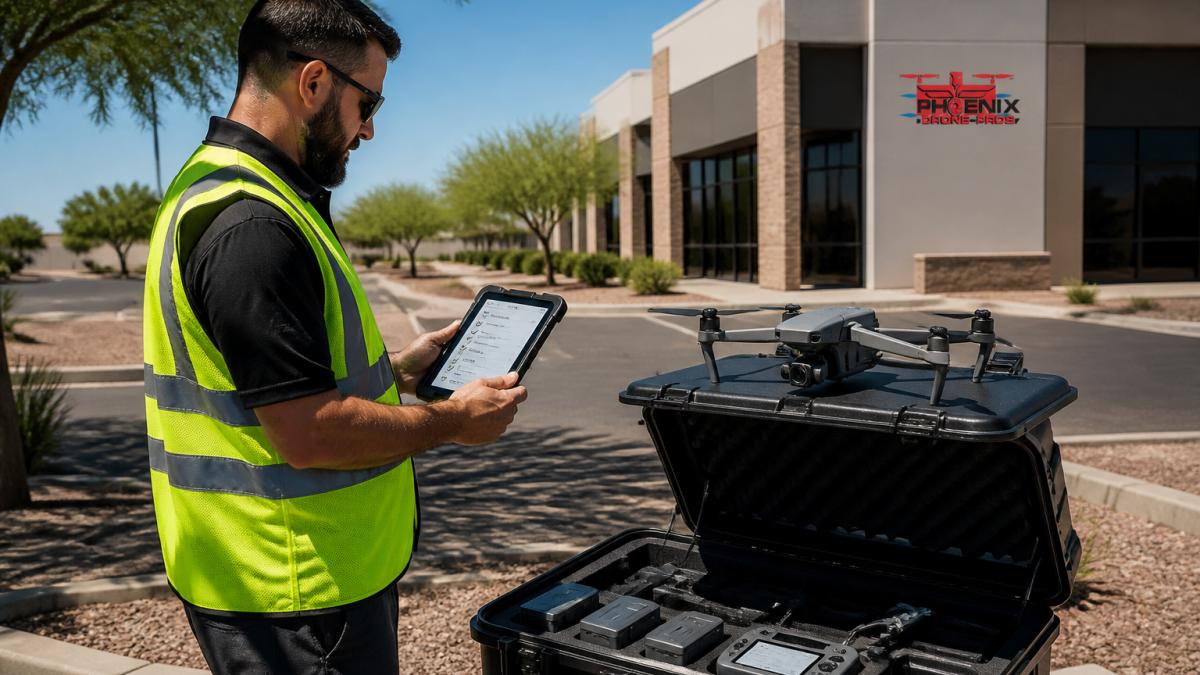
Credentials and Aircraft
- Remote Pilot Certificate current and on hand
- Aircraft registered and registration number on hand
- Registration marking legible on the aircraft
- Battery levels and propeller condition verified
- Firmware and flight app updated
Airspace and Weather
- Airspace class checked on a FAA-approved map
- LAANC or other authorization confirmed for the flight area
- Temporary flight restrictions checked for the shoot window
- Weather and wind within safe limits
- Visibility and cloud ceiling acceptable for the planned altitude
Site and Access
- Property access and owner permission secured in writing
- Gate codes, parking, and site contact confirmed
- Neighboring properties identified and flight path planned to avoid them
- People and vehicle traffic patterns assessed
- Emergency landing spot identified
- Visual line of sight confirmed from the pilot position
Records and Client File
- Certificate of insurance current and available to send
- Client contract or scope of work on file
- Flight log started for the shoot
- Any waiver or authorization documentation saved with the job file
Current Rules Versus Outdated Guidance
A common problem is relying on guidance that no longer applies. The former Section 333 exemption was a path for early commercial operators, but it is not the current framework for routine commercial real estate flights. Current operations run under Part 107, with waivers or authorizations where the standard rules do not fit. If a checklist or a template still references Section 333, it is out of date. Navigating these regulatory layers ensures that the final commercial real estate photography remains compliant and professional throughout the entire production process.
Why the Checklist Matters on Commercial Jobs
For a property-side prep list, our drone photography property checklist covers what to stage before we arrive.
Privacy, Consent, and Property Access on Commercial Listings
Privacy and consent rules matter as much as FAA compliance. The National Association of REALTORS® notes that drone use in real estate may be subject to local regulations and restrictions, including permits and privacy laws, per NAR drone guidance.
Federal rules are not the whole picture. Local regulations can add permit requirements or privacy limits on a flight.
Protect yourself with three habits:
- Get written permission from the property owner
- Tell neighbors when a flight will cross near their property
- Avoid capturing people or private spaces that are not part of the listing
Commercial property access adds another layer. Confirm gate codes, parking, and site contacts before the shoot day.
Book a Compliant Aerial Shoot for Your Next Listing
Compliance is not a box to check once. It is the difference between footage you can use and footage that creates liability.
Our team is FAA certified and fully insured, with over 10 years of commercial drone experience. You get stunning aerial footage and a detailed, accurate view of the property, without the regulatory guesswork.
Ready to put an aerial shoot on your next listing? Our guide to commercial real estate drone marketing shows what to expect and how to book a compliant shoot.
Frequently Asked Questions
Do commercial real estate drone pilots need an FAA Part 107 certificate?
Yes. Any flight tied to paid work, including shooting photos or video for a real estate listing, is a commercial drone operation under FAA rules. The pilot must hold a Remote Pilot Certificate under Part 107, register the aircraft, and follow operating rules such as keeping the drone in visual line of sight. The FAA counted 493,396 certificated remote pilots as of December 2025, and that number is projected to reach roughly 628,600 by 2030, so competition among certified pilots is growing.
How does drone airspace authorization for real estate work near controlled airports?
Before flying, the pilot checks the property's location against FAA airspace maps. In controlled airspace, the pilot needs authorization through the FAA's Low Altitude Authorization and Notification Capability or a waiver before takeoff. Real estate shoots near airports, hospitals, or stadiums often fall in these zones, so the check belongs in the booking process, not the day of the flight. Local rules from the city or homeowners association can add another layer, so confirm both before scheduling.
What should a real estate agent verify before hiring a drone pilot?
Ask for three things: a current FAA Remote Pilot Certificate, proof of aircraft registration, and a certificate of insurance showing liability coverage. Confirm the pilot carries drone insurance for real estate photography that covers the property and any bystanders. Then ask how they handle airspace checks and whether they will sign a contract that assigns the footage rights to you and states delivery dates. A professional operator will supply all of this without hesitation.
Do drone pilots need permission to photograph private property from the air?
FAA rules govern the flight, not the camera, but privacy and trespass law still apply. The National Association of REALTORS® notes that drone use in real estate may be subject to local regulations and restrictions, including permits and privacy laws. Get written consent from the property owner, avoid capturing neighbors' yards or interiors, and follow any local permit requirements. A signed access agreement also settles who is responsible if the drone is damaged on site.
The legal requirements for commercial real estate drone pilots are clear: certification, registration, airspace clearance, insurance, and respect for privacy and access. Getting them right takes experience. Get started with Phoenix Drone Pros and book a compliant aerial shoot that protects your listing and your client.