 listicle
Common Roof Defects Found by Drones
Table of Contents
- Why Drones Reveal Roof Defects Traditional Methods Miss
- Missing or Damaged Shingles
- Roof Leaks and Water Intrusion
- Structural Integrity Issues and Roof Sagging
- Flashing and Ridge Cap Problems
- Thermal Drone Roof Inspection: Detecting Hidden Damage
- Drone Roof Inspection vs. Manual Inspection: Key Differences
- Benefits of Drone Roof Inspections for Property Owners
- Frequently Asked Questions
Last Updated: September 23, 2026
Why Drones Reveal Roof Defects Traditional Methods Miss
Traditional roof inspections rely on ladders, scaffolding, and manual visual assessment from ground level, they're slow, dangerous, and they miss the common roof defects found by drones. Drones equipped with high-resolution cameras and thermal sensors reveal common roof defects found by drones that ground-level inspectors cannot see.
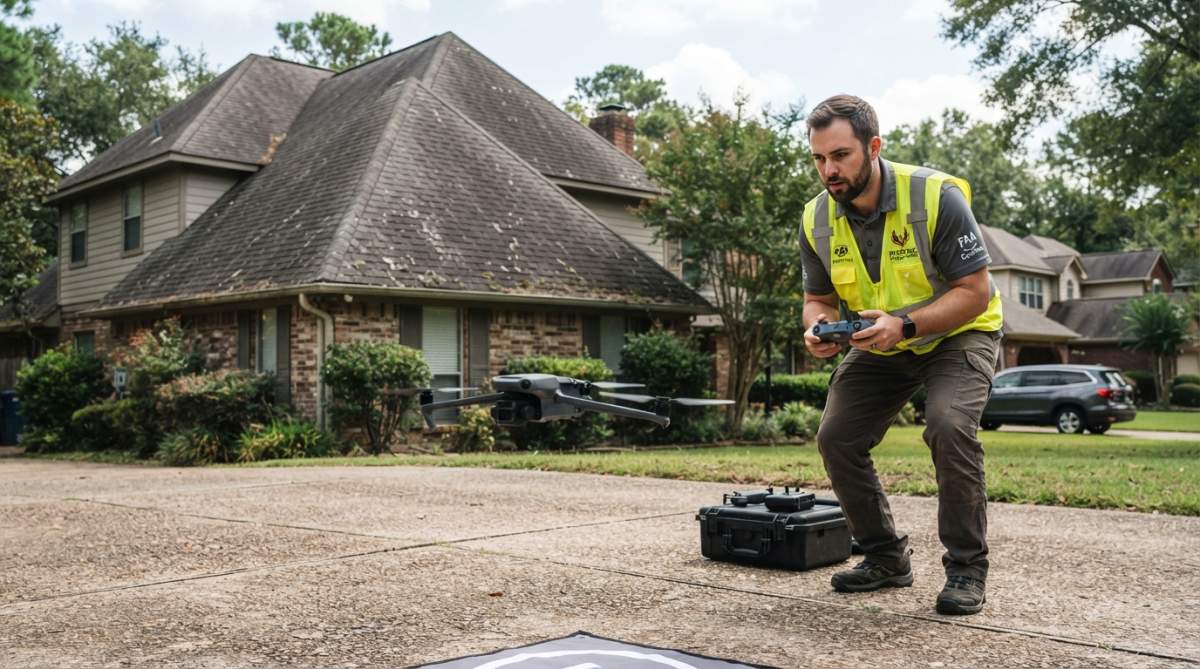
Defects invisible from the ground appear immediately in drone footage: water intrusion, thermal anomalies, structural sagging, and membrane degradation all show up in ways traditional inspections cannot detect.
A property manager at ground level sees maybe 10% of the roof surface. A drone sees everything: ridge caps, flashing, valleys, and the entire membrane system. Thermal imaging reveals heat loss patterns and moisture signatures that indicate hidden damage before it becomes catastrophic.
The result is actionable intelligence. Instead of guessing whether a roof needs repair, you have visual evidence and thermal data that drives real maintenance decisions.
Missing or Damaged Shingles
Missing or damaged shingles are the most visible defect drones detect, and they're often more extensive than ground-level inspections suggest. Asphalt shingles curl, crack, and blow off in wind events, leaving gaps in the protective layer. Drones capture the full extent of shingle loss across the entire roof surface in minutes.
A single missing shingle creates entry points for water intrusion that spreads through decking and into the attic, leading to structural damage if unaddressed.
Drone imagery reveals damage patterns: storm damage clusters by wind direction, age-related degradation scatters across the roof, and UV exposure shows as shingle curling. Each pattern indicates the cause and repair urgency.
The practical advantage: you can prioritize repairs by severity. A few missing shingles in low-stress areas can wait. A cluster of missing shingles near a valley demands immediate attention. Drone imagery makes that distinction clear before you schedule a crew.
Roof Leaks and Water Intrusion
Water intrusion is the silent killer of roof systems. By the time you notice a leak inside, water has already traveled through decking, insulation, and structural framing.
Drones detect water intrusion before interior damage occurs: thermal imaging reveals trapped moisture, visual inspection catches ponding water indicating poor drainage, and blistering shows penetration points.
Early detection is critical: a membrane blister caught during inspection costs hundreds to repair; ignored, it becomes a leak costing thousands in water damage, mold remediation, and structural repairs.
Flashing around penetrations, valleys, and edges is where most leaks start. These areas are difficult to inspect from the ground and easy to miss. Drones provide clear, detailed views of every flashing joint, every sealant line, and every potential failure point. You see exactly where water is most likely to enter.
Structural Integrity Issues and Roof Sagging
Roof sagging indicates lost load-bearing capacity and demands immediate evaluation. Drones detect sagging invisible from the ground by capturing the roof profile from multiple angles.
Structural degradation stems from water damage, inadequate ventilation, or freeze-thaw cycles. Drones reveal the problem before failure occurs.
High-resolution aerial imagery makes the roof line obvious. A sagging section shows as a visible depression in the roof profile. Thermal imaging can sometimes reveal the underlying moisture that caused the structural failure. Together, these tools give you the evidence you need to justify emergency repairs and get contractors mobilized quickly.
The cost of detecting sagging early is minimal. The cost of ignoring it until the roof fails is catastrophic: emergency repairs, potential injury, business interruption, and liability exposure. Drone inspections provide the documentation that justifies preventative action.
Flashing and Ridge Cap Problems
Flashing directs water away from roof penetrations and edges; ridge caps seal the roof peak. Both fail in ways difficult to see from the ground.
Flashing corrosion, separation, and improper overlap create water intrusion pathways. Drones capture these details in sharp focus, showing failed sealant, missing fasteners, and corroded metal.
Flashing problems develop slowly, small sealant gaps become leak pathways, corroded fasteners fail. Drones allow monitoring over time, catching degradation before leaks occur.
The advantage is specificity. You know exactly which flashing sections need attention. You can order materials in advance and schedule repair crews efficiently. You're not guessing or making assumptions based on age. You're responding to actual visual evidence. This proactive approach allows you to address minor issues before they escalate into the more critical signs you need repair.
Thermal Drone Roof Inspection: Detecting Hidden Damage
Thermal imaging reveals what visible light cannot: temperature differences that indicate moisture, heat loss, and structural problems. A thermal drone roof inspection captures the infrared signature of the entire roof surface, showing thermal anomalies that correlate with defects. But understanding how thermal sensors actually work transforms this from magic into actionable intelligence.
Thermal cameras detect infrared radiation based on temperature. Wet roofing material retains heat differently than dry material, moisture cools more slowly at night. Temperature differences appear as color variations in thermal imagery.
Thermal lag is key to detecting moisture. Dry roofing cools quickly; areas with trapped moisture cool slowly because water retains heat. Skilled operators capture imagery within 2-3 hours after sunrise or before sunset when temperature differentials are most pronounced.
Heat loss through the roof shows as thermal anomalies in winter. Gaps in insulation, air leaks, and thermal bridges create distinctive signatures, identifying areas where energy efficiency is compromised.
Thermal imaging reveals roof assembly failures invisible to the eye. Membrane blistering shows as warm spots; delamination creates thermal anomalies at layer boundaries.
Thermal data is quantifiable and reproducible. Modern cameras provide readings accurate to within 2 degrees Fahrenheit, allowing comparison over time to track roof condition changes and identify worsening moisture problems.
Thermal drone roof inspection requires operator training and experience. A certified thermal imaging operator understands emissivity, adjusts camera settings for different roof types, and distinguishes meaningful anomalies from false positives. Professional operators typically complete done flight training to develop the expertise needed for accurate thermal assessment.
Drone Roof Inspection vs. Manual Inspection: Key Differences
The contrast between drone-based assessment and traditional manual inspection is stark across multiple dimensions.
Safety: Manual inspections require workers on steep roofs, working at heights, often in poor weather conditions. OSHA regulations classify roof work as a high-hazard activity; falls account for a significant percentage of workplace fatalities in the construction industry. Drones eliminate that risk entirely. The operator stays on the ground with full control of the flight, and no personnel are exposed to fall hazards.
Coverage: Manual inspectors assess 20-30% of a large roof in a full day. Drones survey the entire surface in 15-30 minutes. A 50,000-square-foot roof takes 2-3 days manually; under an hour by drone.
Cost: Drone inspections cost 40-60% less than manual assessment while providing superior documentation.
Data Quality: Manual inspections produce written notes and limited photos. Drone inspections produce thousands of high-resolution images, thermal datasets, and orthomosaic maps with precise spatial relationships and exact defect location mapping.
Documentation: Drone imagery provides undeniable visual evidence of roof condition. It becomes part of the property record and supports insurance claims, warranty disputes, and repair justifications. Manual inspection notes are subjective, difficult to defend in disputes, and often lost or poorly archived. Drone data is stored digitally, searchable, and reproducible.
Regulatory Compliance: Professional drone roof inspections must comply with FAA Part 107 regulations, which require the operator to hold a Remote Pilot Certificate (obtained through FAA testing), maintain visual line of sight with the aircraft, and follow altitude and airspace restrictions. This regulatory framework ensures operators have formal training in flight safety, weather assessment, and emergency procedures. Manual inspections have no equivalent certification requirement, which means inspector qualifications vary widely.
Repeatability: You can fly the same drone mission repeatedly using the same flight plan and compare results over time. Thermal data from winter inspections can be compared to summer inspections to track how moisture problems evolve. Manual inspections vary based on which inspector performed them, their experience level, and atmospheric conditions on the day of inspection. Drone data is consistent and comparable across time.
Post-Inspection Workflow: After a drone inspection, the data must be processed into actionable reports.
| Inspection Method | Safety | Cost | Coverage | Data Quality | Regulatory Framework | Repeatability |
|---|---|---|---|---|---|---|
| Manual (ladder/scaffolding) | High risk | High | 20-30% | Limited photos | None | Variable |
| Drone visual only | Minimal risk | Moderate | 100% | High-res imagery | FAA Part 107 | Consistent |
| Drone with thermal | Minimal risk | Moderate | 100% + heat data | High-res + thermal | FAA Part 107 | Consistent |
Benefits of Drone Roof Inspections for Property Owners
Property owners gain several concrete advantages from drone-based roof assessment.
Frequently Asked Questions
What are the most common roof defects found by drone inspections?
Drones detect missing or damaged shingles, roof leaks indicated by water stains and ponding water, structural sagging, flashing deterioration, moss and algae growth, granule loss on asphalt shingles, and membrane blistering on flat roofs. Thermal imaging drones also reveal hidden moisture and heat loss patterns that visual inspections cannot see. High-resolution imagery captures visual anomalies at distances that would be unsafe or impossible to reach manually.
How do thermal drone roof inspections differ from standard visual surveys?
Thermal drone roof inspections use infrared sensors to detect temperature variations that indicate moisture intrusion, poor insulation, and structural heat loss. Standard visual surveys capture high-resolution photographs and identify surface defects like missing shingles and cracks. Thermal imaging reveals problems hidden beneath the surface, water trapped in insulation or membrane cavities shows as cooler zones. Together, thermal and visual data provide a complete roof health assessment that neither method alone can deliver.
Is a drone roof inspection worth the investment?
Yes, for most property owners and managers. Drone inspections eliminate the safety hazards of climbing steep or fragile roofs, reduce inspection time, and provide detailed documentation for insurance claims and maintenance planning. The cost of a drone inspection is typically far lower than the cost of emergency repairs from undetected leaks or structural damage. For commercial properties with multiple buildings or complex roof systems, the data-driven maintenance insights often pay for the inspection within months through preventative action.
Can drones identify water leaks and moisture buildup on roofs?
Yes, especially with thermal imaging drones. Thermal cameras detect cooler zones where water has infiltrated insulation or trapped beneath membranes, even when no visible leak is present. Standard visual inspections catch obvious water stains and ponding water, but thermal imaging reveals moisture that has migrated into cavities or under flashing. This early detection prevents costly water damage to interior structures, insulation, and mechanical systems. Orthomosaic mapping from high-resolution visual imagery also documents the exact location of ponding water and drainage obstruction.