 How-to
How to Choose a Drone Photographer in Phoenix?
Last Updated: November 16, 2026
Quick Summary
A good drone photographer in Phoenix holds an FAA Part 107 remote pilot certificate, carries liability insurance naming your property, and has a portfolio of work matching your project type. Compare itemized quotes, confirm turnaround and weather policies, and ask how they handle Phoenix airspace and heat.
- Verify the FAA Part 107 certificate number against the FAA's public registry before signing.
- Request a certificate of insurance that names your property or company as an additional insured.
- Choose an operator whose portfolio matches your project type, such as listing sets or progress captures.
- Compare itemized quotes covering editing, revisions, travel fees, permits and usage license.
- Confirm turnaround time and rush fees in writing, and ask how monsoon weather reschedules are handled.
Table of Contents
- Step 1: Verify Licensing, FAA Certification and Insurance
- Step 2: Review the Portfolio for Real Estate and Commercial Work
- Step 3: Compare Drone Photography Packages and Pricing
- Step 4: Confirm Turnaround Time for Photos and Video
- Phoenix Airspace, Heat and Weather Factors to Ask About
- Booking Your Phoenix Drone Shoot With Phoenix Drone Pros
- Frequently Asked Questions
A drone photographer captures aerial stills and video using an unmanned aircraft, then delivers edited media for marketing, documentation or inspection. Choosing the right one for a Phoenix project starts with knowing what that work involves. The points below apply to any operator you consider.
Real estate agents are the most common clients. Aerial shots show lot shape, roof lines, pools and neighboring context that ground photos miss. Construction project managers use drones to document site progress and build 3D maps. Homeowners with steep or fragile roofs use aerial inspections to avoid climbing. Facility managers and event producers also book aerial work for assessments and cinematography.
If your project needs any of these, you need a photographer who has done that exact type of work. A pilot who handles weddings may not know how to frame a commercial roof or follow a building schedule. Operators who offer a specialized Video Offering Memorandum service for commercial listings, for example, are working in a very different format than a general event shooter.
Step 1: Verify Licensing, FAA Certification and Insurance
Start with paperwork. Commercial drone flights in the United States generally require the pilot to hold an FAA Part 107 remote pilot certificate. Ask for the certificate number and check it against the FAA's public registry before you sign anything. Ask whether the aircraft is registered with the FAA, since registration is a separate requirement.
Next, request proof of liability insurance. This protects your property if something goes wrong during a flight. A common mistake is accepting a verbal "we're insured." Ask for a certificate of insurance that names your property or company as an additional insured.
Watch out: Some operators advertise certification but fly under a personal hobby registration. Confirm the operator's name matches the certificate holder.
Step 2: Review the Portfolio for Real Estate and Commercial Work
A strong portfolio shows the work you need, not just attractive landscapes. Match the samples to your project type before you compare operators, because aerial photography is not interchangeable across use cases.
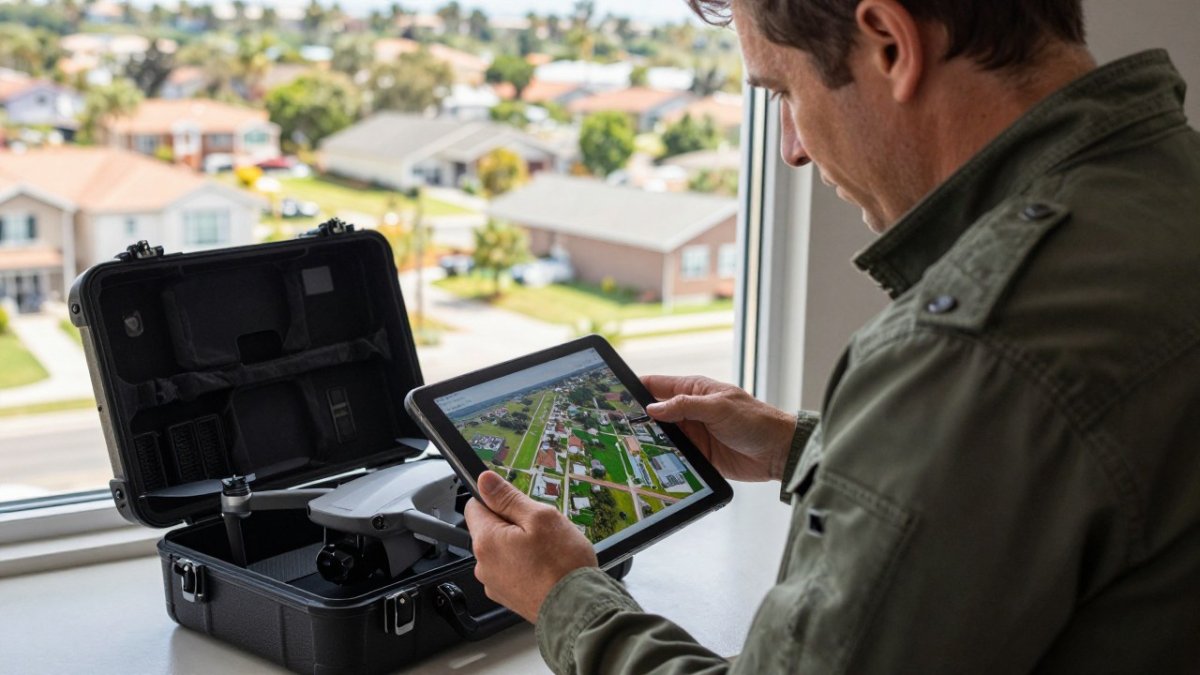
Match the portfolio to your project type
- Residential real estate. Look for listing sets that show the property at multiple angles and altitudes, with straight horizons, consistent exposure and clear views of the lot, roof, pool and neighboring context. Ask how many edited stills a typical listing package includes.
- Commercial real estate. Look for larger sites, parking fields, building envelopes and context shots that show access and surrounding development. Confirm the operator can capture at the altitudes and angles a broker or marketing team needs.
- Construction progress documentation. Ask for progress sets taken across several weeks or months so you can see how consistent the captures are over time. Consistent altitude, framing and file naming matter more than dramatic angles here.
- Roof and property inspections. Look for close, evenly lit images of roof planes, flashing, gutters and HVAC equipment. Ask whether the operator delivers annotated reports or raw images only. Some operators also offer drone solar panel cleaning for rooftop and array work, which is worth asking about if your property has panels.
- Events and proposal coverage. Look for samples that show people and staging areas from a safe distance, with smooth video and clear audio-free storytelling. Confirm the operator can work around guests and venue rules.
What to check inside the samples
Check whether the samples were edited for clarity, not just filtered for drama. Overexposed skies, warped building lines or inconsistent color across a set suggest the operator may struggle with commercial deliverables. Ask for a sample deliverable file, not just a web gallery. The file format and resolution tell you whether the photos will work in print or on a listing site.
Watch out: A portfolio of dramatic landscape and travel footage can look impressive but say nothing about whether the operator can deliver straight, consistent, listing-ready images on a deadline.
Questions that separate a specialist from a generalist
Ask how many projects of your type the operator has completed in the past year, whether they can share a full set rather than selected highlights, and whether they have worked with your industry's common delivery requirements. A pilot who handles weddings may not know how to frame a commercial roof or follow a building schedule. A short portfolio review with these questions will tell you more than a gallery of highlights.
Step 3: Compare Drone Photography Packages and Pricing
Pricing varies widely, and the cheapest quote is not always the best value. Compare what each package includes: number of photos or video minutes, editing, revisions, drone flight time on site and any travel fees. Ask each operator to itemize the quote so you can compare providers fairly.
What drives the price of a drone photography package
Most quotes are built from a handful of cost drivers. Ask how each one is handled before you compare totals:
- Flight time and site count. A single-location real estate shoot with 20 to 30 edited stills is a different job from a multi-building construction capture across several acres. More locations, more setup and more flight time raise the price.
- Deliverables. Stills, video, 3D models, orthomosaic maps and inspection reports are priced differently. A package that includes video editing or mapping processing costs more than a photo-only package.
- Editing and revisions. Basic color correction and straightening are usually included. Heavy retouching, sky replacement, video color grading and multiple revision rounds may be billed separately or capped in the package.
- Permit and airspace work. Flights near controlled airspace or restricted sites can require FAA authorization, coordination time or a waiver. Some operators build that into the quote; others add it as a line item.
- Travel fees. Operators often include a local radius and charge per mile beyond it. Ask what the radius is and how travel is calculated.
- Turnaround and rush fees. Standard delivery may be several business days; rush delivery usually costs extra. Confirm both the standard window and the rush premium in writing.
- Licensing and usage rights. Commercial use, print use, broadcast use and resale may be priced differently. Clarify what license comes with the base quote and what costs more.
What a quote should spell out
A quote you can compare should list the number of edited images or video minutes, the resolution and file formats, the number of revision rounds, the delivery method and deadline, the usage license, and any travel or permit fees. If a quote is a single lump sum with no breakdown, ask for the itemization before you decide.
Watch out: A low base price can hide per-image editing fees, travel surcharges or a limited usage license that forces you to pay again for print or broadcast use.
Deposit, cancellation and rescheduling terms
Ask what deposit is required to hold the date, whether it is refundable, and how rescheduling works if weather grounds the flight. Monsoon-season wind and dust can force a move on short notice, so confirm whether weather reschedules carry a fee and how much notice is required for a cancellation.
Deliverables and file handoff
Confirm the delivery format before you book: full-resolution JPEGs, RAW files, MP4 video, or mapping files such as GeoTIFF or OBJ. Ask whether the gallery link stays live, how long it remains available, and whether you receive a permanent download. If you need the files for a listing site, a print vendor or a client handoff, confirm the resolution and color profile meet those requirements.
Pricing depends on the project's scope, the number of shoot locations, the dates you need and how you want the deliverables delivered. Contact the company directly through its website for a current quote.
The article's cost drivers and what a quote should spell out can be scanned side by side:
| Cost driver | What to ask | Watch for |
|---|---|---|
| Flight time and site count | How many locations are included | More sites mean more setup and flight time |
| Editing and revisions | Whether basic editing and revision rounds are included | Heavy retouching may be billed separately |
| Permit and airspace work | Whether FAA authorization is built into the quote | Restricted sites can add a line item |
| Travel fees | Local radius and per-mile charge beyond it | Surcharges can hide in a low base price |
| Turnaround and rush fees | Standard window and rush premium in writing | Rush delivery usually costs extra |
| Licensing and usage rights | Which license comes with the base quote | Print or broadcast use may cost more |
Step 4: Confirm Turnaround Time for Photos and Video
Turnaround time matters when a listing is going live or a construction milestone is due. Ask how many business days editing takes after the flight, and whether rush delivery costs extra. Confirm how the files are delivered: cloud link, direct download or an uploaded gallery.
Get the deadline in writing as part of your agreement.
Phoenix Airspace, Heat and Weather Factors to Ask About
Phoenix presents conditions that affect every flight. Ask the operator how they handle these before booking:
- Airspace: Parts of the metro area sit near controlled airspace around Sky Harbor International Airport. Ask whether the pilot checks FAA airspace maps and obtains authorization when needed.
- Heat: Summer temperatures can reduce battery performance and shorten flight time. Ask about battery management and scheduling flights for cooler hours.
- Weather: Monsoon-season winds and dust storms can ground a flight on short notice. Ask about the rescheduling policy.
A pilot who answers these questions clearly is likely to plan carefully. Operators who also run search and rescue thermal drone missions, for instance, tend to be experienced with demanding flight conditions and emergency-grade planning. That same discipline helps keep wedding flights safe and unobtrusive, making a wedding drone photography planning guide a useful next step when assessing how aerial coverage fits into an event.
Booking Your Phoenix Drone Shoot With Phoenix Drone Pros
Before booking any operator, prepare a short list of questions: certification number, insurance certificate, sample deliverables, itemized quote, turnaround deadline and weather policy. Visit the company's website to review available services and request a quote for your project. Clear answers before you book protect your schedule, your budget and your property.
Frequently Asked Questions
How much does it cost to hire a drone photographer?
Pricing depends on the size of the property or site, the number of flights, whether you need photos only or video too, and how quickly you need deliverables. Because rates vary by project, the most reliable approach is to request a written quote that lists exactly what is included. Phoenix Drone Pros can provide current pricing and a custom quote through its website. Ask any provider whether the quote covers travel, editing and licensing of the images.
Can I fly a drone over my property in Arizona?
Many property owners can fly over their own land, but the rules depend on airspace, proximity to airports, and whether the flight is commercial. Commercial drone flights in the United States generally require a pilot holding a Part 107 remote pilot certificate from the FAA. Before any flight, check the airspace over the site and confirm the pilot holds current certification and liability insurance.
How can I verify that a drone photographer is qualified?
Ask for the pilot's FAA Part 107 remote pilot certificate number and confirm it is current. Request a certificate of liability insurance naming you as an additional insured if the work is on your property. Review a portfolio of recent work similar to your project, and ask for references from real estate agents, builders or property managers in the Phoenix area.
How long does it take to receive drone photos and videos?
Turnaround depends on the scope of the shoot and the editing required. Photo sets for a single listing are often delivered within a few business days, while video edits and multi-site construction documentation can take longer. Ask the provider to state turnaround times in the contract, including when raw files versus edited files will be delivered.