 How-to
7 Steps to Use Drone Technology for Detecting Water Leaks in Roofs
Last Updated: November 19, 2026
Quick Summary
Drone technology for detecting water leaks in roofs uses a radiometric thermal camera paired with a visual camera to map temperature differences, so trapped moisture shows up as a distinct patch while the pilot stays on the ground. A seven-step workflow runs from flight planning and camera setup through grid flight, on-site review, ground truthing with a moisture meter, and a final report.
- A thermal drone roof inspection reads surface temperature, since wet material holds heat differently than dry material.
- The best survey window is usually a short period after sunset, once the roof sheds heat but wet spots hold theirs.
- Overlap every grid pass by roughly a third so the thermal sensor has redundant coverage.
- Ground truth each suspect anomaly with a moisture meter before it goes in the report.
- A radiometric thermal survey costs more than a visual-only capture but is the only version that finds hidden moisture.
Table of Contents
- Why Drone Technology for Detecting Water Leaks in Roofs Beats a Ladder Walk
- Thermal Drone Roof Inspection for Leak Detection: How It Works
- Infrared Roof Inspection for Moisture Detection: Reading the Images
- The 7-Step Workflow for a Drone Roof Inspection
- Best Drone for Roof Inspection: What to Look For
- Drone Roof Inspection Cost and When It Pays Off
- Regulations, Privacy, and Flight Safety
- Scheduling Your Thermal Roof Inspection
- Frequently Asked Questions
Why Drone Technology for Detecting Water Leaks in Roofs Beats a Ladder Walk
Drone technology for detecting water leaks in roofs replaces the ladder walk with a safer, faster aerial survey. See the roof leak drone detection service and what it finds.
A ladder walk puts a person on a steep pitch with poor footing. One slip ends the day.
Here is the real difference:
- Safety: no climbing, no fall risk
- Coverage: every plane and valley gets captured
- Speed: a full roof survey takes minutes, not hours
- Records: images you can keep and compare later
The Occupational Safety and Health Administration treats falls as a leading cause of workplace death, which is reason enough to keep feet off the roof.
Below, we walk through the full process, from flight planning to leak confirmation.
Thermal Drone Roof Inspection for Leak Detection: How It Works
A thermal drone roof inspection for leak detection works by reading surface temperature.
The drone carries two cameras: a thermal sensor and a standard visual camera. The thermal sensor maps heat. The visual camera shows the shingles, flashing, and seams.
Infrared thermography is the science behind this. It captures temperature differences and turns them into an image.
A few things make the survey work:
- The roof must be dry on top, with moisture held underneath
- Sun and shade must create a temperature gap
- The flight must happen while that gap is still visible
For a deeper look at the technique, see our guide on thermal imaging for drone roof inspections.
Infrared Roof Inspection for Moisture Detection: Reading the Images
An infrared roof inspection for moisture detection succeeds or fails on image interpretation. The camera shows patterns; the pilot has to read them correctly.
Wet insulation cools and warms slower than dry insulation. That lag creates the thermal anomaly you are hunting for.
Radiometric Data and Temperature Differences
A radiometric sensor records a temperature value for every pixel, not just a color. That matters because it lets you measure the gap between a wet patch and dry roof.
A common mistake is treating every dark blob as a leak. In practice, a vent, a shadow, or a patch of ballast can look identical in color. Radiometric data helps separate real moisture from look-alikes.
Survey Conditions and False Positives
Timing decides everything. Fly too early and the roof is uniform. Fly too late and the sun has erased the contrast.
The best window is usually a short period after sunset, once the roof has shed its heat but wet spots still hold theirs.
Watch out for false positives from:
- Ponds of standing water that never drained
- HVAC units dumping condensate
- Reflective metal flashing
- Shaded sections that cool at a different rate
Each one can mimic a leak. Cross-check every anomaly against the visual image before you call it.
The 7-Step Workflow for a Drone Roof Inspection
A repeatable workflow is what separates a useful survey from a set of pretty pictures. Most articles describe the technology and stop there; the sequence below is the part that actually determines whether you find the leak.
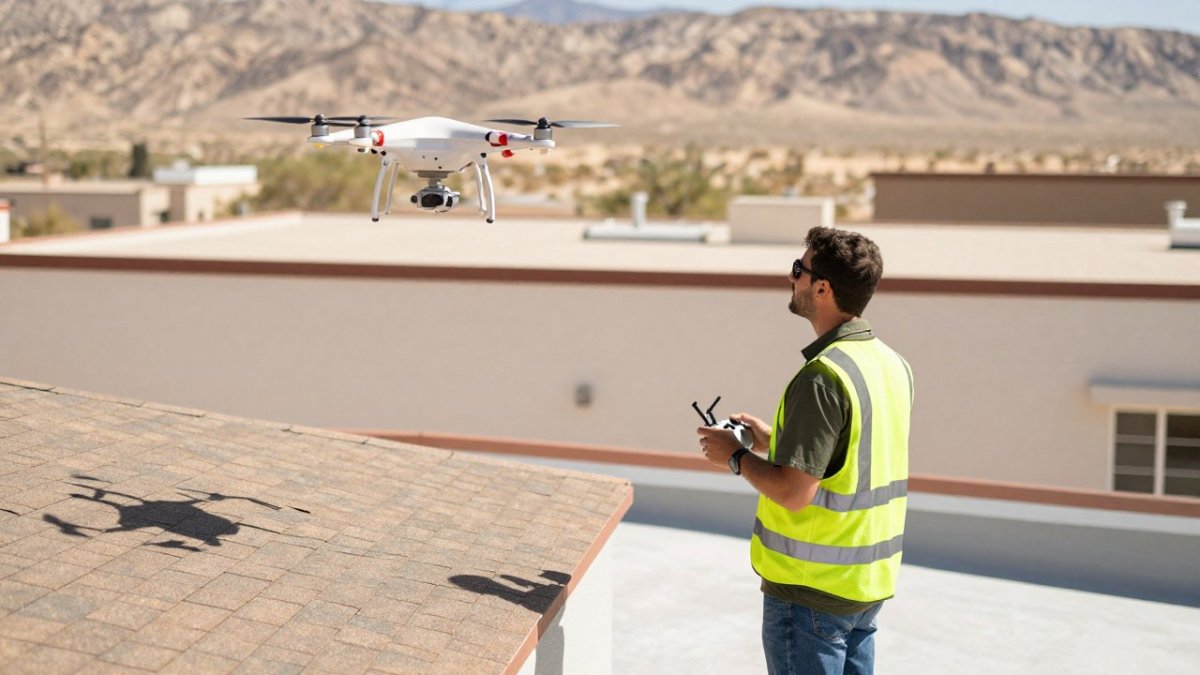
- Plan the flight. Map the roof into a grid before launch, note the pitch changes, valleys, and penetrations, and check airspace through the FAA's B4UFLY or LAANC system. Pick the survey window based on the thermal conditions described above, not on convenience. A common pattern is to schedule the visual pass in daylight and the thermal pass after sunset on the same day so the two datasets align.
- Set the camera. Lock exposure and white balance so the visual images are comparable across the roof, and confirm the thermal range covers the expected surface temperatures. Set the thermal palette to a high-contrast option for capture and keep the raw radiometric file; you can re-render the palette later, but you cannot recover data you did not record.
- Fly the grid. Overlap every pass by roughly a third so no section is missed and the thermal sensor has redundant coverage. Hold a consistent altitude and speed; sudden changes blur the thermal frame and make anomalies harder to compare. Fly into the wind on the outbound leg for a steadier capture.
- Capture visual and thermal. Run both cameras on the same path so every thermal frame has a matching visual frame. This pairing is what lets you cross-check an anomaly against the shingle, seam, or flashing that may explain it.
- Review on site. Flag anomalies while you still have daylight and line of sight, and note the roof coordinates or grid reference for each suspect. Reviewing later from a desk loses the context that makes a dark patch interpretable.
- Ground-truth the suspects. Confirm each one in person or with a moisture meter before it goes in the report. A thermal image suggests; it does not prove.
- Deliver the report. Pair each image with a location, a finding, and a confidence level. A report that lists anomalies without locations forces the reader to re-fly the roof.
Ground Truthing and Leak Confirmation
A pin-type moisture meter reads resistance between probes and works well on exposed decking and insulation; a pinless meter reads capacitance and is better on finished membrane where you cannot penetrate.
This step kills false positives. Because confirming where moisture sits helps distinguish an early membrane breach from a surface issue, Sunset Restoration can help connect drone findings with a closer roof inspection.
Here is the seven-step sequence we follow for every drone roof survey.
| Step | What to do | Key detail |
|---|---|---|
| 1 | Plan the flight | Map a grid, check airspace via B4UFLY or LAANC |
| 2 | Set the camera | Lock exposure and white balance, keep raw radiometric file |
| 3 | Fly the grid | Overlap every pass by roughly a third |
| 4 | Capture visual and thermal | Run both cameras on the same path |
| 5 | Review on site | Flag anomalies while daylight and line of sight remain |
| 6 | Ground-truth the suspects | Confirm with a moisture meter or physical check |
| 7 | Deliver the report | Pair each image with location, finding, confidence level |
Best Drone for Roof Inspection: What to Look For
The best drone for roof inspection carries a radiometric thermal camera and enough stability to hold a steady shot. Everything else is secondary.
Here is what matters:
- Radiometric thermal sensor for measurable temperatures
- High-resolution visual camera for detail
- Gimbal stabilization for sharp images
- Wind resistance for open rooftops
For specific model picks, see our roundup of the best drones for residential roof inspections.
Drone Roof Inspection Cost and When It Pays Off
Drone roof inspection cost depends on roof size, access, and how detailed a report you need, so pricing is not a single flat rate.
The main factors that affect pricing are:
- Roof size and complexity. A simple gable roof on a single-family home takes a fraction of the flight time of a commercial roof with multiple levels, HVAC clusters, and parapets. Complexity drives both flight time and image-review time, and review is often the larger labor line.
- Access and site conditions. A roof that requires travel, lift access, or coordination with a building manager costs more than one you can launch beside. Steep pitches and obstructions slow the grid and add passes.
- Report depth. A set of images is cheaper than a written report that pairs each anomaly with a location, a confidence level, and a recommended next step. The report is usually where the value sits, so cutting it rarely saves money in practice.
- Thermal versus visual only. A radiometric thermal survey costs more than a visual-only capture because the equipment and the interpretation time are both higher, but it is the only version that can find moisture that has not yet stained a ceiling.
Compare that with a manual inspection. A ladder or roof walk carries labor, fall-protection setup, and the risk of a fall, which OSHA treats as a leading cause of workplace death.
When drone inspection is clearly worthwhile:
- You suspect a leak but cannot see it from the ground or the attic.
- The roof is steep, tall, or hard to access safely.
- You need a record of roof condition for insurance, a warranty claim, or a real estate transaction.
- You want to catch water intrusion before it rots a deck or stains a ceiling, since early detection is almost always cheaper than a repair.
When it may not be:
- The roof is flat, low, and safely walkable, and a visual check answers the question.
- You already have a confirmed leak point and need a repair, not a survey.
For a full breakdown of how the two approaches compare line by line, read our drone vs manual roof inspection cost guide.
Regulations, Privacy, and Flight Safety
Flying a roof survey in the United States means following Federal Aviation Administration rules for commercial drone operations. If you would rather learn to fly these missions yourself, our Done flight training covers the training involved.
Privacy matters too. Neighbors have a reasonable expectation of privacy, so keep the camera on the roof and avoid adjacent windows.
Safety rules we do not bend:
- Never fly over people without cause
- Respect temporary flight restrictions
- Keep visual line of sight at all times
The Federal Aviation Administration publishes the current rules for commercial drone flights.
Scheduling Your Thermal Roof Inspection
Booking a thermal roof inspection is simple once you know the conditions.
Before the pilot arrives:
- Confirm the roof is dry on top
- Note any known leak spots
- Provide access to the roof edge if possible
Our team covers the preparation in detail in how to prepare for a drone roof inspection.
Water damage rarely announces itself.
Phoenix Drone Pros brings FAA-certified pilots, full insurance, and more than a decade of commercial drone experience to roof surveys.
Get started with Phoenix Drone Pros and find the leak before it finds your ceiling.
Frequently Asked Questions
Can infrared technology detect roof leaks?
Yes. An infrared roof inspection for moisture detection works because wet insulation holds heat differently than dry material. After the sun heats the roof, saturated areas cool at a different rate and show up as temperature differences on a thermal camera. The catch is that the drone records a thermal anomaly, not proof of a leak. A qualified inspector still confirms the finding with a moisture meter or visual check before anyone quotes a repair.
What conditions are best for detecting roof moisture with a drone?
Timing matters more than the drone. Solar loading warms the roof first, so the clearest thermal contrast usually appears a few hours after peak sun or during a slow evening cooldown. Avoid heavy wind, rain, standing water, and heavy cloud cover, all of which blur temperature differences. A dry roof with steady sun before the flight gives the radiometric sensor the cleanest data to work with.
How accurate are thermal drone roof inspections?
A drone roof inspection is accurate at flagging where moisture likely sits, but it is a screening tool, not a final diagnosis. Thermal anomalies can come from wet insulation, but also from ponding water, HVAC exhaust, skylight glare, or a patch of different membrane. That is why a solid workflow pairs the thermal survey with high-resolution RGB imagery and ground verification before anyone commits to a repair scope.
How much does a drone roof inspection cost?
Drone roof inspection cost depends on roof size, building height, access, and how detailed the report needs to be, so there is no single number. For current pricing or a quote on a specific property, contact Phoenix Drone Pros through the website.