 how-to
How to Interpret Drone Roof Inspection Data (2026 Guide)
Table of Contents
- Why Drone Roof Inspection Data Beats a Visual Walkaround
- Thermal Drone Roof Inspection Benefits: Seeing What the Eye Can't
- How to Read Thermal Imaging Data for Moisture and Insulation Gaps
- Identifying Roof Damage in High-Resolution Imagery
- Drone Roof Inspection Report Examples: What a Useful Deliverable Looks Like
- Best Software for Drone Roof Analysis: Matching Tools to Your Workflow
- From Flight to Final Report: A Step-by-Step Workflow
- Legal and Insurance Liability When Using Drone Inspection Data
- Frequently Asked Questions
Last Updated: September 16, 2026
Why Drone Roof Inspection Data Beats a Visual Walkaround
Learning how to interpret drone roof inspection data starts with what a walkaround cannot capture. A drone roof inspection uses an unmanned aircraft with thermal and high-resolution sensors to survey a roof surface, then translates that imagery into a condition assessment. At Phoenix Drone Pros, our FAA-certified pilots have flown these surveys for over a decade, and the pattern is consistent: the eye catches what is visible from the ladder line, while the sensor catches what is happening beneath it.
Thermal Drone Roof Inspection Benefits: Seeing What the Eye Can't
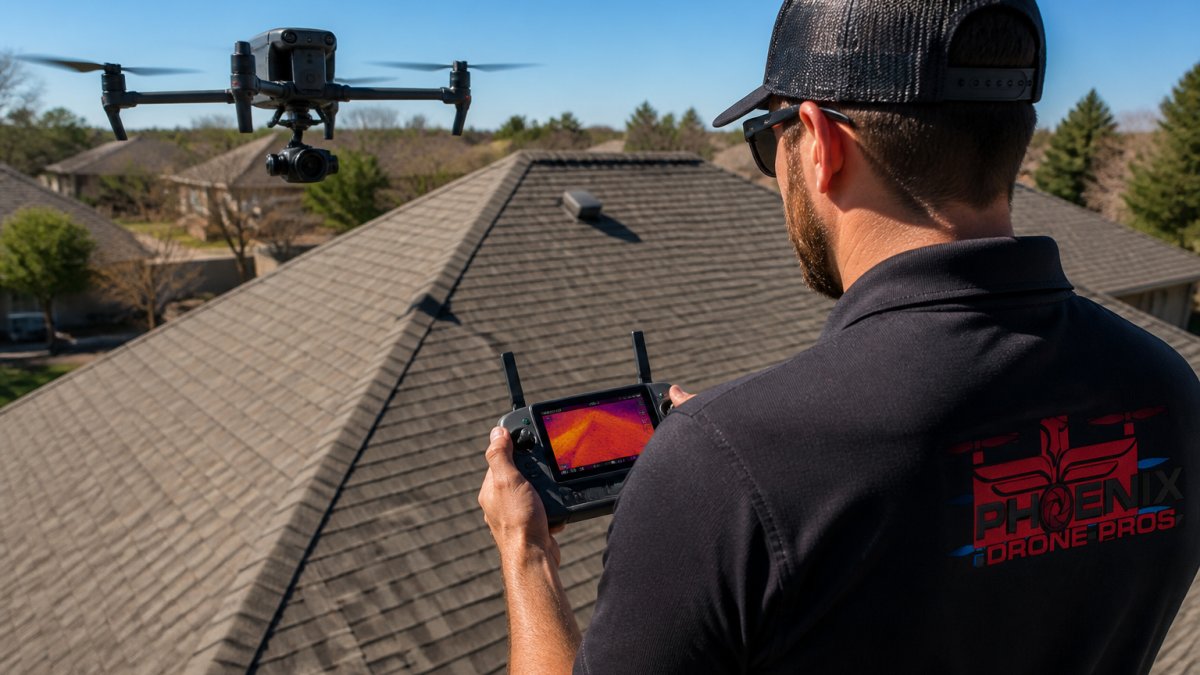
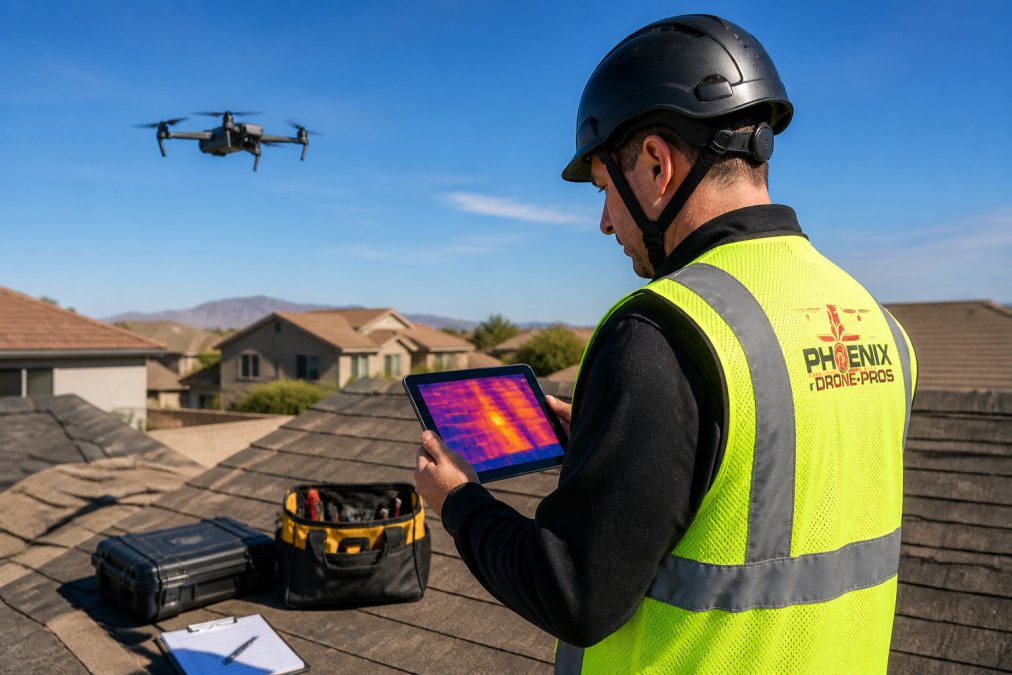
The core benefit of a thermal drone roof inspection is contrast. Infrared thermography measures surface temperature differences across the roof plane, and those differences map to what is happening underneath.
How to Read Thermal Imaging Data for Moisture and Insulation Gaps
Reading thermal data comes down to one rule: moisture and insulation problems appear as temperature differences, not visible marks. Separating real anomalies from lookalikes depends on physics, not on how dramatic the image looks.
The mechanics behind a thermal reading
A radiometric thermal sensor converts infrared radiance to temperature using three inputs you control: emissivity, reflected apparent temperature, and distance. Get any wrong and every reading on the flight is skewed.
- Emissivity describes how efficiently a surface radiates heat. Bare metal flashing, aluminum HVAC housings, and polished fasteners have low emissivity and read as false hot or cold spots unless corrected.
- Reflected apparent temperature is the background IR bouncing back at the sensor. A clear sky is a cold reflector; overcast is warmer. Left at default, a metal roof can read 20°F or more off.
- Distance and atmospheric transmission matter less at 30-100 feet, but matter on large commercial roofs where the drone may be 200 feet up.
Delta-T: the number that decides whether you fly at all
Thermographers talk about Delta-T, the temperature difference between the roof surface and ambient air, or between wet and dry roof sections. Moisture detection depends on it. If roof and air are nearly the same temperature, wet and dry insulation look identical because no heat flow reveals the difference.
A working sequence for reading the thermal layer
- Confirm the conditions. Check the flight log for ambient temperature, roof surface temperature, wind, and time relative to sunset. If Delta-T is under roughly 10°F, flag the thermal layer as low-confidence.
- Set a baseline. Identify the roof's expected temperature range using a known-dry reference area, usually a north-facing slope or a visually verified section.
- Scan for contrast, not absolutes. Look for areas deviating from surrounding surface temperature. A 5°F deviation on a low-Delta-T flight is noise; on a high-Delta-T flight it is a candidate.
- Cross-reference against the visual layer. Every thermal anomaly needs a corresponding high-resolution image. No visual confirmation, no finding.
- Check the weather log. Solar loading, wind, and recent rain shift the thermal signature. A roof rained on 12 hours ago shows surface water patterns, not subsurface intrusion.
- Flag and rank. Mark anomalies by size and severity, not by how dramatic they look.
Temperature Anomalies and False Positives
False positives are the biggest source of bad inspection reports. A warm patch is not automatically water damage.
Common causes of misleading thermal readings include:
- Solar loading. Roof sections facing the sun longer read warmer regardless of moisture. South and west slopes are the usual suspects on late-afternoon flights.
- Ventilation exhaust. Bathroom, kitchen, and dryer vents create heat plumes that read as anomalies. Trace the plume to the vent stack before calling it moisture.
- Reflective surfaces. Metal flashing and HVAC equipment bounce heat in ways that confuse the signature, especially when emissivity was left at default.
- Insulation gaps. Missing insulation reads similar to wet insulation in some conditions. The tell is shape: missing insulation follows regular patterns (batt seams, framing bays); wet insulation spreads irregularly.
- Surface water. Ponding water reads cool by day and warm at night. Check the weather log before flagging it as intrusion.
- Debris and shading. Leaves, tree shadows, and equipment shadows create sharp-edged thermal edges that do not match the soft gradients of real moisture.
Identifying Roof Damage in High-Resolution Imagery
High-resolution imagery confirms what the thermal layer flagged. At sufficient pixel resolution, granule loss, hairline cracks, and shingle degradation become measurable rather than guessed at.
Work through the visual layer in this order:
- Granule loss: Look for lighter, rougher patches where the protective surface has worn away.
- Hairline cracks: Fine fractures in shingle or membrane, often invisible from the ground.
- Shingle degradation: Curling, lifting, or missing tabs along the roof pitch.
- Ridge alignment: Check that ridge caps sit straight and flush.
- Moss colonization: Organic growth that traps moisture against the surface.
Granule Loss, Hairline Cracks, and Shingle Degradation
Each defect type has a distinct visual signature. Granule loss reads as a color shift from uniform gray to mottled lighter tone. Hairline cracks appear as thin dark lines that do not follow the shingle pattern. Shingle degradation shows as edge lifting or shadowing where tabs separated.
Drone Roof Inspection Report Examples: What a Useful Deliverable Looks Like
A useful drone roof inspection report answers three questions: what is damaged, where, and how urgent. Most reports fail on the third, and almost all fail on a fourth when money is on the line: can this report support an insurance claim? Comprehensive documentation of these defects serves as the primary defense in preventing water damage before minor structural compromises escalate into costly interior failures.
The standardized template
| Section | What It Contains | Why It Matters |
|---|---|---|
| Executive summary | Overall roof condition rating and top-priority findings | Gives decision-makers the headline |
| Methodology | Flight date, time, weather conditions, sensor model, emissivity and reflected-temperature settings, Delta-T at capture | Establishes the report as a defensible record, not an opinion |
| Thermal layer | Annotated temperature anomalies with radiometric values | Documents subsurface findings |
| Visual layer | High-resolution defect photos, each geotagged | Confirms what thermal flagged |
| Severity ranking | Priority 1-3 classification with defined criteria | Drives repair scheduling |
| Geotagged map | Defect locations overlaid on roof plan | Lets contractors find the issue |
| Baseline data | Flight date, conditions, sensor settings | Enables comparison next inspection |
| Limitations | What the inspection did not cover, and why | Protects the inspector and sets client expectations |
The severity ranking and methodology section are the two most reports skip, and the two an adjuster looks for first.
Writing severity language that holds up
A severity ranking only works if criteria are defined in the report itself. Vague terms like "minor" and "major" mean different things to a homeowner, roofer, and adjuster. Define them:
- Priority 1, Active or imminent loss. Active moisture intrusion, missing shingles exposing decking, structural deflection, or anything letting water into the building envelope. Repair within days.
- Priority 2, Progressive deterioration. Granule loss exposing mat, hairline membrane cracks, failed sealant at penetrations, or localized shingle lifting. Repair within the current season.
- Priority 3, Monitor. Cosmetic wear, early moss colonization, or isolated findings with no pathway to intrusion. Re-inspect at the next scheduled cycle.
What insurance adjusters actually look for
Carriers increasingly accept drone inspection reports as supporting documentation, but acceptance is not automatic. Rejected reports read as photo dumps with captions. Accepted reports share four traits:
- A stated methodology. The report says when the flight happened, the weather, the sensor used, and the settings applied, letting the carrier assess whether conditions supported the findings.
- Findings tied to specific damage types. "Hail impact bruising on the south slope, 14 strikes documented" is usable. "Storm damage" is not.
- Geotagged, timestamped imagery. Every photo carries location and time metadata, proving the condition existed on the inspection date.
- A clear distinction between observed and inferred. Thermal anomalies are inferred; visual defects are observed. Label them differently, conflating the two loses credibility in a claim review.
A worked example
A residential asphalt shingle roof inspected after a spring storm. The thermal layer shows three anomalies on the south slope; the visual layer confirms hail bruising on two and a vent stack flashing failure on the third. The report should read:
- Finding 1 (Priority 1): Active moisture intrusion at vent stack flashing, south slope, grid coordinate B-4. Thermal anomaly confirmed by visual evidence of failed sealant and lifted flashing. Recommend immediate repair.
- Finding 2 (Priority 2): Hail impact bruising, south slope, grid coordinates B-2 through B-3. 14 documented strikes with granule displacement. No active intrusion observed. Recommend repair within season.
- Finding 3 (Priority 3): Thermal anomaly at south slope grid B-5, no visual confirmation. Possible insulation gap or surface moisture. Recommend re-inspection at next cycle under higher Delta-T conditions.
Best Software for Drone Roof Analysis: Matching Tools to Your Workflow
Choosing software for drone roof analysis comes down to three variables: how much data you process, whether you need 3D modeling, and whether reports go to insurers or contractors.
The main categories break down like this:
- Photogrammetry platforms stitch overlapping images into an orthomosaic and 3D model. Best for construction progress documentation and large commercial roofs.
- Thermal analysis tools handle radiometric data and false color mapping. Best for moisture detection.
- Report builders turn findings into a client-facing deliverable. Best for inspectors handing off to property owners.
- Point cloud processors convert LiDAR data into measurable 3D surfaces. Best for structural integrity assessment.
From Flight to Final Report: A Step-by-Step Workflow
The workflow from flight to report has six stages, and skipping any one degrades the output.
- Flight path planning. Map roof geometry, set flight altitude for target pixel resolution, and confirm no-fly restrictions.
- Sensor calibration. Verify thermal and visual sensors are calibrated before takeoff.
- Data capture. Fly overlapping passes for photogrammetry, plus dedicated thermal passes.
- Data processing. Stitch imagery, generate the orthomosaic, and align the thermal layer.
- Analysis. Identify anomalies, cross-reference thermal and visual, and eliminate false positives.
- Report generation. Apply your standardized template and rank findings by severity.
Legal and Insurance Liability When Using Drone Inspection Data
Liability is the angle most guides ignore, and it can cost you the most. Drone inspection data sits at the intersection of aviation law, property law, and insurance claims.
Three points to keep straight:
- Pilot certification. Commercial drone operations require a certified remote pilot under FAA Part 107. Flying without it voids most liability coverage.
- Property access. You need permission to fly over private property. A roof inspection does not automatically grant it.
- Data as evidence. Inspection imagery can be subpoenaed in a claim dispute. Store it with the same care as any legal record.
Frequently Asked Questions
Are drone roof inspections accurate enough for insurance claims?
Yes, when performed by FAA-certified pilots using calibrated sensors. High-resolution imagery and thermal data can reveal granule loss, moisture intrusion, and hairline cracks that a ground-level visual check misses. Most insurers accept drone inspection reports as supporting documentation, especially when the report includes geotagged images, temperature readings, and a clear damage assessment. Accuracy depends on flight altitude, sensor calibration, and the pilot's ability to distinguish real damage from false positives like shadows or wet debris.
What are the benefits of thermal drone roof inspection compared to standard aerial photos?
Thermal drone roof inspection benefits include moisture detection beneath the surface, identifying insulation gaps, and spotting temperature anomalies that indicate water damage. Standard high-resolution photos show surface issues like missing shingles or cracks, but thermal imaging reveals what's happening underneath. Combining both data types gives a more complete roof condition assessment, helping property managers prioritize repairs and plan predictive maintenance before small issues become structural problems.
How do I identify roof damage from aerial imagery without a background in roofing?
Start by looking for visual patterns: granule loss appears as lighter or darker patches on shingles, hairline cracks show as thin dark lines, and moss colonization creates green or black clusters. Water damage often appears as staining or discoloration near seams and penetrations. Thermal images use false color mapping to show temperature differences, with cooler or warmer spots indicating moisture or insulation gaps. A standardized inspection report from a professional service translates these signals into plain-language findings.
Do I need a license to fly a drone for roof inspections?
Commercial drone roof inspections require a Remote Pilot Certificate under FAA Part 107. The pilot must also follow airspace rules, maintain visual line of sight, and avoid flying over people without a waiver. For homeowners or real estate agents hiring a service, verify the operator holds current FAA certification and liability insurance. This protects you if a drone crashes or causes property damage during the inspection.