 how-to
How to Market Drone Roof Inspection Services
Table of Contents
- Understanding Your Market for Drone Roof Inspections
- How to Pitch Drone Services to Roofing Contractors
- Benefits of Thermal Drone Roof Inspections
- Drone Roof Inspection Pricing Models and Service Tiers
- Building a Lead Generation Strategy for Inspection Services
- Creating Client-Facing Marketing Materials and Reports
- Insurance, Liability, and Compliance in Your Marketing
- Frequently Asked Questions
Last Updated: September 28, 2026
Understanding Your Market for Drone Roof Inspections
Property managers, contractors, and homeowners all need market drone roof inspection services done safely and quickly. Before you pitch, know who buys these services, the market breaks into clear segments with different pain points.
Residential homeowners want safety, no workers on steep roofs. Commercial property managers need speed and actionable data. Roofing contractors use inspections to sell repairs and close bigger jobs. Solar companies need assessments before installation. Each segment needs a different message: homeowners want safety reassurance; contractors want proof that inspections help them sell more work.
How to Pitch Drone Services to Roofing Contractors
Roofing contractors are your most profitable segment, they handle inspections regularly, understand data value, and have budget. Your pitch: drone inspections help them close bigger jobs and reduce liability.
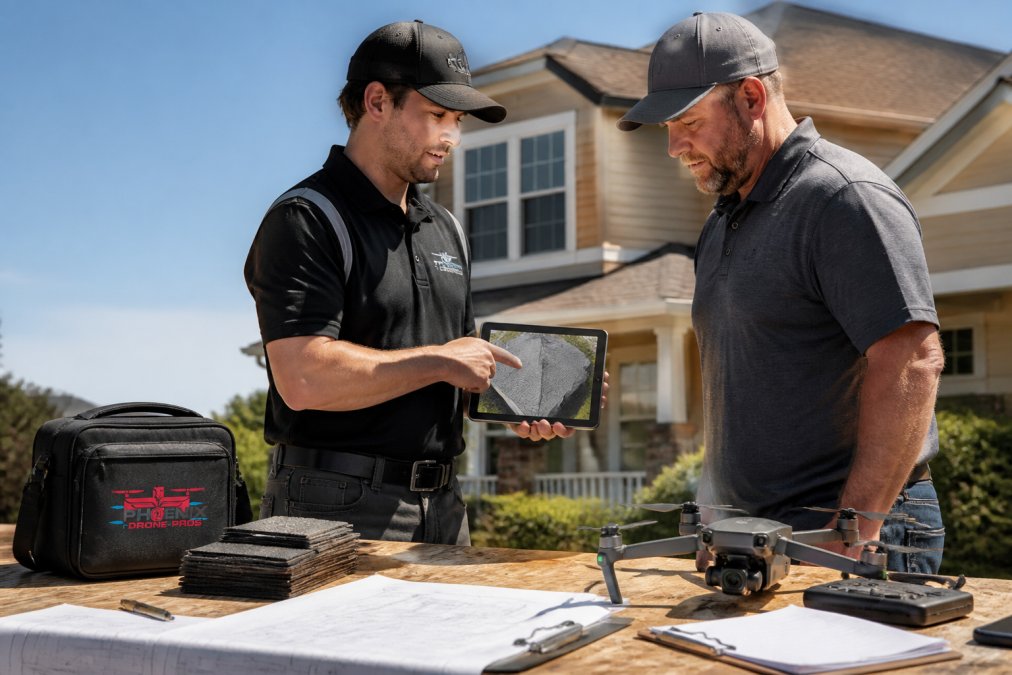
Lead with results, not features: "Our inspections identify hidden damage customers miss, so you write bigger proposals." Focus on three things: Speed (20-30 minutes vs. hours on a ladder), Safety (no workers' comp claims or liability), and Documentation (thermal data proves damage to homeowners).
The pitch email should be short. Two paragraphs maximum. Include one sample image from a recent inspection. Show them exactly what they'll get.
Roofing contractors respond to contractors who understand their business. Mention their challenges directly. "We know you lose jobs because homeowners don't believe the damage is as bad as you say. Our thermal images prove it."
Benefits of Thermal Drone Roof Inspections
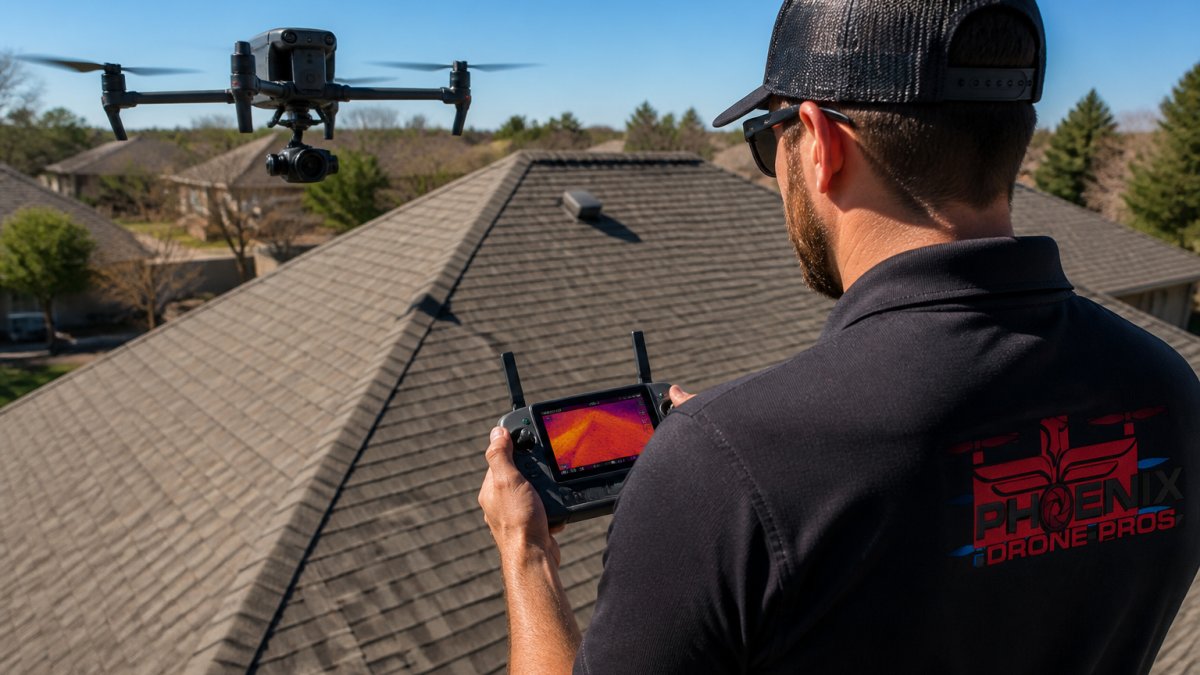
Thermal imaging separates basic inspections from professional-grade services by revealing hidden problems. A standard camera shows what you can see; thermal imaging reveals missing insulation, water damage, and ventilation issues as temperature variations.
Thermal data reveals moisture damage (cool spots), insulation gaps (temperature anomalies), ventilation problems (hot spots), and structural issues. Clients pay more because it's actionable evidence, not just pictures.
Market thermal inspections on accuracy, they catch problems visual inspection misses, reducing callbacks, disputes, and insurance claims. The combination of high-resolution imagery and thermal data gives clients the proof they need to make decisions.
Drone Roof Inspection Pricing Models and Service Tiers
Most drone pilots undercharge, not understanding their value. You have three pricing models: per-inspection, hourly, or subscription.
Per-inspection pricing: Flat fee per roof (residential: 1,200-2,500 sq ft, 30 minutes). Hourly pricing: Works for variable complexity. Subscription pricing: Monthly fee for contractors and property managers needing regular inspections. Start with per-inspection; add subscriptions as you grow.
Compete on speed and quality, not price. When quoting, specify deliverables: raw footage, edited video, written report with thermal analysis, orthomosaic maps. Each addition increases value.
Building a Lead Generation Strategy for Inspection Services
B2B sales require a structured approach. Target contractors with 5+ employees, established insurance, and overlapping service areas. Use Google Maps and LinkedIn to verify company size and find decision-makers.
Use a tiered outreach sequence: Week 1 research on LinkedIn, Week 2 send personalized email with sample thermal image (3-4 sentences), Week 3 phone follow-up, Week 4 case study or video, then ask for referrals.
Track open rates, response rates, and conversion rates. Below 20% open rate means improve subject lines; below 5% response rate means clarify your value proposition.
Build partnerships with roofers, solar installers, property managers, and adjusters. Offer 10-15% referral fees formalized in a one-page agreement. One active partnership can generate 3-5 leads monthly.
After 10-15 inspections, create case studies with before-and-after thermal images, original estimates, what you revealed that was missed, and client quotes. Contractors share these with prospects and adjusters, more valuable than pitch emails.
Your website builds credibility, not leads. Include services, pricing, sample reports, case studies, contact info, FAA Part 107 number, and insurance details. This removes objections before prospects call.
Attend Chamber meetings, roofing associations, and trade shows with business cards and sample footage on a tablet. Track pipeline metrics: contacts, responses, calls scheduled, and closes. If you contact 20 per month and close 1, adjust outreach volume accordingly.
Don't rely on online ads yet. Google Ads and Facebook ads for B2B drone services typically have poor ROI because the audience is too broad and the decision cycle is too long. Focus on direct outreach and partnerships first. Once you have 20+ case studies and a proven sales process, online advertising becomes more effective.
Creating Client-Facing Marketing Materials and Reports
Your inspection report is your most important marketing asset. It's the deliverable clients judge you on, and it's also the tool they use to sell repairs to homeowners or justify maintenance to property managers. A professional report builds trust, justifies premium pricing, and generates referrals.
Raw footage is useless, process it into actionable reports. Stage 1: Capture high-resolution stills, thermal video, and standard video from multiple angles. Use consistent naming and back up to cloud storage immediately.
Stage 2: Use orthomosaic software (Pix4D, DroneDeploy, WebODM) to stitch images into roof maps, and thermal software (FLIR Tools, DroneDeploy) to annotate thermal images. Most pilots skip this, processed data is what clients pay for.
Stage 3: Use a template with cover page, executive summary, 8-12 labeled photos, 4-6 annotated thermal images, orthomosaic map, 2-3 video clips, detailed findings, recommendations, and contact info. Use Adobe InDesign, Canva Pro, or specialized software like Hover for professional PDFs.
Make reports easy to understand. Use clear language. Avoid technical jargon. Explain what thermal imaging shows: "Cool spots on the thermal image indicate areas where water has penetrated the roof structure. This moisture can cause rot and structural damage if not addressed." Label every image with location and description. Use arrows and annotations to point out specific problems.
Include measurements and data. Contractors need numbers. If you identify a roof section with moisture damage, estimate its size: "Approximately 200 square feet of the east-facing roof shows signs of moisture penetration." If thermal imaging shows temperature variations, include the temperature range: "The affected area reads 15-20 degrees cooler than surrounding roof sections, indicating trapped moisture."
Create collateral for contractors to use with homeowners. Contractors often need to explain drone inspections to homeowners who have never seen one. Create a one-page flyer explaining what drone inspections are, why thermal imaging matters, and what homeowners can expect. Include sample images and your contact information. Contractors can print this and hand it to homeowners before the inspection. This positions you as the expert and makes the contractor's job easier.
Build a report library. After 20-30 inspections, you'll have examples of common roof problems: moisture damage, insulation gaps, ventilation issues, structural damage, etc. Create a library of annotated thermal images and photos for each problem type.
Clients share your reports with contractors, adjusters, and decision-makers. Every report is marketing. Make it so professional and detailed that people ask "Who did this inspection?" and call you directly.
Track report delivery and feedback. When you send a report, follow up a few days later: "Did you have any questions about the inspection? Would you like to discuss next steps?" Ask for feedback: "What was most helpful about this report?" Use this feedback to improve your template. If clients consistently ask for more detail on a particular issue, add that to your standard report.
Insurance, Liability, and Compliance in Your Marketing
This is the part most drone pilots skip. It's also the part that protects your business and builds client confidence.
Frequently Asked Questions
Do I need a license to fly a drone for roof inspections?
Yes. To market and operate drone roof inspection services commercially, you must hold an FAA Part 107 remote pilot certificate. This requires passing the FAA knowledge test and maintaining currency through recurrent training. Without certification, you cannot legally charge for inspection services. Many drone operators use training platforms like Drone Pilot Ground School to prepare for the exam, which covers regulations, safety, and operational limits that directly affect how you market your services and what clients you can serve.
How should I structure drone roof inspection pricing models for different clients?
Pricing models typically fall into three categories: per-inspection flat rates based on roof size and complexity, hourly rates for larger commercial projects, and subscription models for property managers with multiple buildings. Residential inspections often command flat fees ranging from basic assessments to detailed thermal imaging reports. Commercial clients typically prefer hourly or project-based pricing tied to deliverables like orthomosaic maps and 3D models. You can find pricing calculators and benchmarks to help you establish competitive rates while accounting for equipment costs, insurance, and post-processing time.
What makes thermal imaging inspections stand out to property managers and contractors?
Thermal drone roof inspections detect moisture intrusion, insulation gaps, and temperature anomalies invisible to standard visual inspection. This capability identifies problems before they become costly repairs, which appeals directly to facility managers focused on preventative maintenance and risk mitigation. When marketing thermal inspections, emphasize the ability to spot structural integrity issues early, reduce emergency repairs, and provide data-driven documentation for insurance claims. This technical advantage justifies premium pricing and differentiates your services from competitors offering only high-resolution imagery.
How can I find clients for drone roof inspection services?
Target B2B channels first: contact roofing contractors, property management companies, construction firms, and commercial real estate brokers directly. Build relationships with insurance adjusters who recommend inspections to clients with damage claims. Create case studies showing before-and-after thermal imaging results and damage detection outcomes. Use LinkedIn to connect with facility managers and construction project leads. Attend industry events, join roofing and construction associations, and develop referral partnerships with complementary service providers. For residential clients, partner with real estate agents who need aerial property documentation for high-end listings.