 listicle
Why Drone Technology Trends Matter for Small Businesses
Table of Contents
- How Drone Technology Trends Are Reshaping Small Business Operations
- FAA Part 107 Certification Requirements for Commercial Drone Operations
- Drone Inspection Services for Small Business: Roofing, Construction, and Beyond
- How to Use AI in Drones for Beginners: A Practical Starter Guide
- Real-World ROI: Calculating the Financial Impact of Drone Adoption
- Insurance and Liability: Protecting Your Small Business Drone Operations
- Hardware vs. Service-as-a-Service: Choosing the Right Drone Model
- Conclusion: Turning Drone Technology Trends into Business Results
- Frequently Asked Questions
Last Updated: September 27, 2026
How Drone Technology Trends Are Reshaping Small Business Operations
Drone technology trends now decide which small businesses win contracts and which get undercut. Aerial data collection has moved from novelty to standard line item for roofing, construction, real estate, and facility management. At Phoenix Drone Pros, we have watched this shift from the pilot's seat for over a decade: businesses that adopt aerial data early cut inspection costs and win bids competitors cannot match.
FAA Part 107 Certification Requirements for Commercial Drone Operations
Every commercial flight requires a Remote Pilot Certificate under FAA Part 107. There is no small-business exemption: if you charge for the flight, you need the certificate. But the certificate is only the entry ticket, the compliance work that follows trips up most small operators.
The certificate itself
The requirements are straightforward:
- Be at least 16 years old
- Pass an aeronautical knowledge exam at an FAA-approved testing center
- Complete a TSA background check
- Register each aircraft over 0.55 pounds
- Keep the certificate current with recurrent training
The exam covers airspace classes, weather, loading, emergency procedures, and crew resource management. Most candidates need several weeks of study. The FAA's official Part 107 resources lay out the full knowledge areas and testing process.
The operational rules that actually govern your jobs
Holding the certificate does not mean you can fly anywhere. Four operating limits shape nearly every mission:
- Altitude: 400 feet above ground level, unless you are within 400 feet of a structure and remain within its lateral footprint.
- Visual line of sight: You must be able to see the aircraft unaided (corrective lenses are fine, binoculars are not) at all times.
- People on the ground: You cannot fly over people who are not directly participating in the operation unless you meet specific category requirements.
- Airspace: Class B, C, D, and surface Class E airspace require authorization before launch.
How LAANC changes the timeline
The Low Altitude Authorization and Notification Capability (LAANC) is the FAA's system for near-real-time airspace authorization. Instead of waiting days or weeks for a manual waiver, you submit a request through an approved provider app and typically receive a response in seconds to minutes for flights inside pre-approved grid altitudes.
What that means in practice:
- Check the airspace map for your job site before you quote the work.
- If the site is in controlled airspace, confirm the grid ceiling LAANC will approve.
- Submit the authorization request the same day you plan to fly.
- Keep the authorization record with your flight log.
The compliance habits that protect you
Small operators who stay out of trouble tend to share a few habits:
- Pre-flight checklists for every mission, signed and dated.
- Flight logs that record location, altitude, duration, and authorization numbers.
- Maintenance records for batteries, props, and firmware updates.
- A current airspace check on the day of the flight, not the day you booked it.
What this costs you in practice
Certification is a fixed cost; the recurring cost is time, airspace checks, authorization requests, and log maintenance on every job. For a business flying a handful of missions a month that is manageable; for one flying daily across multiple jurisdictions, it is a workflow to systematize from day one.
Drone Inspection Services for Small Business: Roofing, Construction, and Beyond
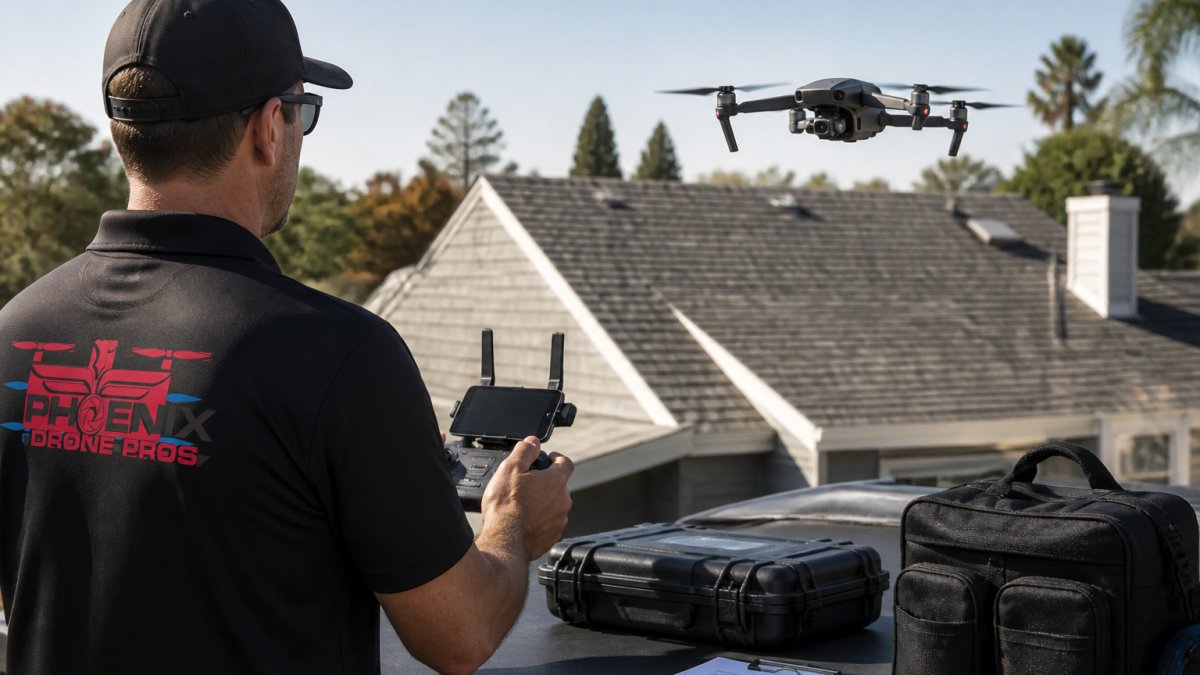
Drone inspection services for small business replace risky manual inspections with fast, documented aerial surveys. A roof that would take a crew half a day to walk is captured in a single flight, with thermal imaging revealing moisture intrusion and insulation gaps the naked eye misses.
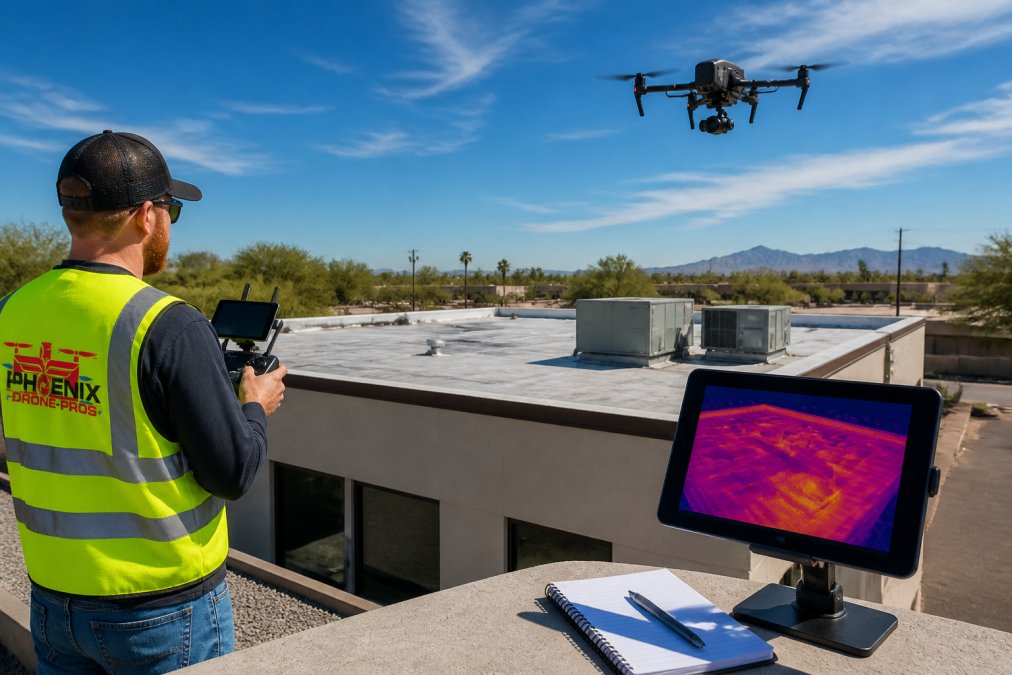
The applications go well beyond roofing:
- Roofing and property management: thermal imaging spots leaks, damaged shingles, and failing seals before they become structural problems
- Construction progress documentation: weekly flights create a visual record that resolves disputes and supports draw requests
- Infrastructure maintenance: bridges, towers, and solar arrays get inspected without scaffolding or lift rentals
- Real estate marketing: aerial media and video offering memoranda help high-end listings stand out
How to Use AI in Drones for Beginners: A Practical Starter Guide
A workable starting sequence:
- Choose one mission type. Pick a single use case, such as roof inspections or site progress photos, and master it before expanding.
- Fly a simple grid pattern. Automated flight planning apps handle this for you; you just set the boundary and altitude.
- Upload the images. Cloud platforms process them into orthomosaics, 3D models, and measurements.
- Review the AI output. Progress tracking and anomaly detection flag changes between flights.
- Deliver a report. Export a PDF or share a link with your client.
The learning curve is short: most operators are comfortable with a basic mapping workflow within a few flights.
Real-World ROI: Calculating the Financial Impact of Drone Adoption
Drone ROI comes down to three numbers: labor cost reduction, inspection speed, and new revenue. Build the calculation around your own jobs, not industry averages.
| Cost Category | Manual Method | Drone Method | What Changes |
|---|---|---|---|
| Inspection labor | Crew of 2-3, full day | 1 pilot, 1-2 hours | Fewer hours billed |
| Equipment | Ladders, lifts, harnesses | Aircraft + software | Lower rental spend |
| Safety exposure | Fall risk on every job | Ground-level operation | Reduced liability |
| Documentation | Photos and notes | Geotagged maps and models | Better dispute defense |
| Turnaround | Days | Same day to 48 hours | Faster client response |
Insurance and Liability: Protecting Your Small Business Drone Operations
Two coverage types matter most:
- Liability coverage protects you if the aircraft damages property or injures someone
- Hull coverage covers the aircraft itself against crash or loss
For small businesses, the cleanest path is to work with an operator who already carries full coverage and certification. That transfers the regulatory and insurance burden off your books.
Hardware vs. Service-as-a-Service: Choosing the Right Drone Model
The buy-versus-hire decision is the most consequential choice a small business makes about drone work, and most guides reduce it to a vague "it depends." It hinges on flight volume, mission complexity, and whether you want to carry the compliance and insurance burden yourself.
The real cost of ownership
The sticker price of an aircraft is the smallest part of ownership. A realistic annual cost stack for a small operator looks like this:
- Aircraft and sensors: a mid-range enterprise platform with a thermal payload
- Software subscriptions: mapping and processing platforms commonly run several hundred dollars per month, with engineering-grade photogrammetry suites priced annually in the thousands
- Insurance: liability and hull coverage, typically quoted annually based on flight hours and mission type
- Maintenance and consumables: props, batteries, gimbal repairs, firmware support
- Certification and recurrent training: the Part 107 certificate and its renewal cycle
- Your time: flight planning, processing, reporting, and recordkeeping on every job
A simple break-even framework
You do not need a spreadsheet to make this call. Answer three questions:
- How many billable flights per month? Count only missions a client is paying for, not practice flights.
- What does a service provider charge per comparable mission? Get two or three quotes for the same scope.
- What is your fully loaded annual ownership cost? Use the stack above, including your own time at a realistic hourly rate.
The comparison that matters
| Factor | Buy Hardware | Service-as-a-Service |
|---|---|---|
| Upfront cost | Aircraft, sensors, software, training | Per-project fee |
| Recurring cost | Subscriptions, insurance, maintenance | Bundled into the fee |
| Best for | High, recurring volume on similar missions | Occasional, seasonal, or specialized work |
| Certification | You hold Part 107 | Provider holds it |
| Insurance | You carry it | Provider carries it |
| Airspace compliance | Your responsibility | Provider's responsibility |
| Sensor flexibility | Limited to your payloads | Access to thermal, LiDAR, and specialized sensors |
| Downtime risk | You absorb it | Provider absorbs it |
| Data ownership | Yours, permanently | Depends on the contract, read it |
The hidden costs of ownership nobody quotes you
The costs that surprise first-time buyers are rarely the aircraft:
- Crash and repair downtime. A grounded aircraft during a busy season means turning down work.
- Battery degradation. Flight batteries lose capacity over cycles and are a recurring replacement cost.
- Software lock-in. Once your workflow and client deliverables depend on a specific processing platform, switching is expensive.
- Training time. New sensors and software mean new learning curves, and that time is unpaid.
- Insurance exclusions. Policies often exclude the exact missions, over people, beyond visual line of sight, night operations, that clients ask for most.
The hybrid path most small businesses land on
The cleanest answer for many small businesses is a hybrid: own a basic aircraft for routine, low-risk work you do often, and hire a service provider for specialized missions, thermal surveys, LiDAR, complex structures, or jobs in airspace you are not authorized for. You keep the margin on the work you do constantly and avoid capital outlay on capabilities you use a few times a year.
What to look for in a service provider
If you go the service route, the provider's credentials are your protection. Confirm they hold a current Part 107 certificate, carry liability and hull coverage with limits that satisfy your client's contract requirements, can produce a certificate of insurance on request, and maintain flight logs and authorization records. A provider who cannot produce those on day one is transferring their risk onto your business.
Conclusion: Turning Drone Technology Trends into Business Results
The gap between businesses using aerial data and those still climbing ladders widens every year. Certification, insurance, and software all have real costs, but the returns show up in faster inspections, safer job sites, and service lines your competitors cannot match.
Frequently Asked Questions
What are the primary benefits of adopting drone technology for small businesses?
Small businesses use drones to cut operational costs, improve safety, and capture data that would otherwise require expensive equipment or risky manual labor. For example, a roof inspection that once required ladders and harnesses can be done in minutes with a drone, reducing labor costs and eliminating fall risks. Drones also provide high-resolution aerial imagery for marketing, construction progress tracking, and insurance documentation.
What regulatory considerations should small businesses know regarding FAA drone usage?
Any commercial drone operation in the U.S. requires a Remote Pilot Certificate under FAA Part 107. This involves passing an aeronautical knowledge exam, registering drones weighing over 0.55 pounds, and following operational rules like flying below 400 feet and within visual line of sight. Small businesses must also check airspace restrictions; controlled airspace requires LAANC authorization. Staying compliant avoids fines and ensures insurance validity. Many small businesses partner with FAA-certified providers like Phoenix Drone Pros to handle regulatory burdens while focusing on their core work.
How can small businesses integrate drone data into their existing workflows?
Start by identifying a specific pain point, such as slow roof inspections or inaccurate construction progress reports. Then choose a drone service or software that exports data in formats compatible with your current tools, like PDF reports for clients or CSV files for project management software. For construction, platforms can integrate with project management software, allowing seamless data flow. For real estate, high-resolution images and videos can be uploaded directly to MLS listings. The key is to pilot a small project, measure time savings, and scale from there.
What are the most significant challenges for small businesses using drones?
The biggest hurdles are regulatory compliance, insurance, and upfront costs. Part 107 certification takes time and study, and commercial drone insurance can be expensive for high-risk operations. Hardware and software subscriptions can represent significant upfront costs. However, many small businesses avoid these challenges by hiring service providers like Phoenix Drone Pros, which offers FAA-certified pilots, full insurance, and pay-per-project pricing. This model eliminates capital expenses and lets businesses test drone applications without long-term commitments.