 how-to
Why Hire FAA Certified Drone Pilots: 7 Key Reasons
Table of Contents
- What FAA Certification Means for Commercial Drone Operations
- How to Verify FAA Drone Pilot Certification Before You Hire
- Drone Pilot Liability Insurance Importance for Your Project
- Risks of Hiring Unlicensed Drone Operators
- Legal Requirements and FAA Enforcement for Commercial Drone Use
- Professionalism and Reliability: What Certified Pilots Bring to Projects
- Conclusion: Protecting Your Investment with FAA Certified Drone Pilots
- Frequently Asked Questions
Last Updated: September 26, 2026
What FAA Certification Means for Commercial Drone Operations
Hiring someone to fly a drone over your property is not the same as hiring a certified commercial pilot. That difference matters when you hire FAA certified drone pilots for any paid project, from real estate listings to roof inspections. FAA certification, formally called a Remote Pilot Certificate under Part 107, is the legal baseline for commercial drone work in the United States.
Part 107 is the rule set the FAA created for small unmanned aircraft systems. Anyone flying a drone for money or business must hold a Remote Pilot Certificate. To get it, a pilot must pass a knowledge test at an FAA-approved testing center, pass a background check, and recertify on a set schedule.
This matters to you as a client for three reasons:
- A certified pilot has passed a federal aeronautical knowledge test
- Certification proves the pilot understands airspace regulations and flight safety
- The certificate is verifiable through official FAA records
The FAA publishes the rules that govern commercial drone operations on its own site, and those rules apply to every paid flight.
How to Verify FAA Drone Pilot Certification Before You Hire
Verification takes about five minutes, and it protects your project. You do not need to take anyone's word for it. The FAA maintains public records, and you can check them yourself.
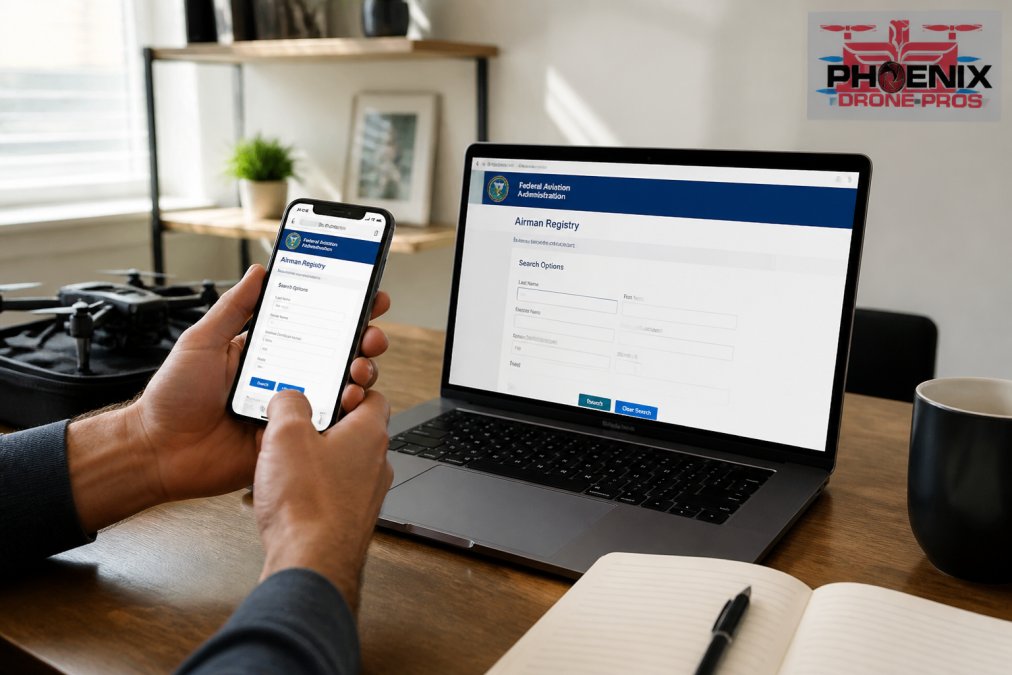
Checking the FAA Airman Registry
The FAA Airman Registry is a searchable public database. Ask your pilot for their full legal name and certificate number. Then search the registry to confirm the certificate is active and matches the person in front of you. A lapsed or suspended certificate will show up here.
Requesting a Certificate of Authorization
A Certificate of Authorization, or COA, covers specific operations like flying in controlled airspace. Ask the pilot to show their authorization for your job site. If your property sits near an airport, this document proves the pilot can legally fly there.
- Confirm the pilot's name matches their Remote Pilot Certificate
- Search the FAA Airman Registry for an active certificate
- Ask for proof of liability insurance
- Request the COA or waiver for your specific location if needed
- Get the certificate and policy numbers in writing
Drone Pilot Liability Insurance Importance for Your Project
Drone pilot liability insurance importance comes down to one question: who pays when something goes wrong? A drone can damage a roof, hit a person, or fall onto a car. Without proper coverage, that bill can land on you, and the mechanism that decides whether it does is the pilot's certification status.
Why Certification and Coverage Are Linked
Most commercial drone liability policies include a certification warranty. In plain terms, the policy only responds if the flight was conducted legally. Under Part 107, a flight conducted for a business purpose by someone without a Remote Pilot Certificate is not a legal commercial operation. When that happens, the insurer can deny the claim on the grounds that the pilot breached a policy condition, leaving the injured party or property owner to pursue the operator directly, or to file against their own policy.
The Two Coverage Types That Matter
A commercial drone policy typically carries two distinct coverages:
- General liability, covers third-party bodily injury and property damage. This is the coverage that protects you and your property.
- Hull coverage, covers the drone itself. This protects the pilot's equipment, not you.
For client work, general liability is the one that matters. Ask for a certificate of insurance (COI) before the flight and confirm three things: the policy is current, the named insured matches the pilot or company you hired, and the coverage limits are appropriate for the project. A homeowner's policy or a hobbyist plan generally will not cover commercial work, and many exclude business use outright.
Additional Insured and Certificates of Insurance
If your contract or lender requires it, you can ask to be named as an additional insured on the pilot's general liability policy for the duration of the project. This gives you direct access to the policy if a claim arises, rather than relying on the pilot to pursue it on your behalf. The pilot's insurer issues an endorsement reflecting this, and it should appear on the COI.
What to Check on the Certificate
- Named insured matches the entity you hired
- General liability limits are stated and adequate for the site
- Policy effective dates cover your project window
- Additional insured endorsement is listed if you requested one
- Certificate holder information is correct
Many clients find that their own insurance will not step in for an illegal flight. That is the real reason insurance and certification go together, not as a formality, but as the mechanism that determines whether a claim gets paid.
Risks of Hiring Unlicensed Drone Operators
The risks of hiring unlicensed drone operators are larger than most people expect. The cheap quote often hides costs that show up later, and the exposure runs to the client as well as the operator.
The Liability Chain
When an uncertified pilot flies a commercial mission, several things happen at once:
- The flight is illegal. Every paid flight by an uncertified operator violates Part 107.
- The insurance is likely void. As covered above, most commercial policies require a certified pilot. No certification, no coverage.
- The client is exposed. If the drone damages property or injures someone, the injured party can pursue the operator, and, depending on the facts, the client who hired them. A client who directed the work or controlled the site may be named in a claim.
- Recovery is difficult. If the operator has no insurance and limited assets, there may be nothing to collect against, leaving the client to absorb the loss or file against their own policy.
FAA Enforcement Consequences
The FAA can issue warnings and civil penalties for illegal commercial drone operations. Penalties can reach tens of thousands of dollars per violation, and the agency has pursued cases against operators who flew for business without certification. Enforcement can also reach clients who contracted the illegal flight, particularly where the client knew or should have known the operator was not certified.
Operational and Quality Risks
Uncertified pilots often lack the training that certification requires. That shows up in the deliverables:
- Poorly framed or unusable aerial imagery
- Missed coverage of the areas that matter for the project
- Inconsistent results across multiple flights
- No pre-flight airspace check, which can lead to a flight in restricted airspace
A Simple Comparison
| Factor | Certified Pilot | Uncertified Operator |
|---|---|---|
| Legal to fly commercially | Yes | No |
| Commercial insurance valid | Typically yes | Typically void |
| FAA enforcement exposure | Low | High |
| Client liability exposure | Limited | Significant |
| Deliverable reliability | Consistent | Variable |
The savings from a cut-rate operator rarely survive one incident. One damaged roof, one denied claim, or one FAA inquiry wipes out any discount, and can cost far more than the project was worth.
Legal Requirements and FAA Enforcement for Commercial Drone Use
FAA enforcement is real, and it applies to the operator and sometimes the client. The FAA treats any flight tied to a business purpose as commercial, even a single listing photo.
Professionalism and Reliability: What Certified Pilots Bring to Projects
Certified pilots tend to run tighter operations. The certification process forces them to learn flight planning, pre-flight inspection, and safety protocols. That discipline shows up on the job.
A certified pilot will:
- File a flight plan and check airspace before arriving
- Run a pre-flight inspection on the aircraft
- Coordinate with air traffic control when required
- Deliver footage on a schedule you can plan around
Conclusion: Protecting Your Investment with FAA Certified Drone Pilots
The gap between a certified pilot and an uncertified one is the gap between a protected project and an exposed one. Certification, insurance, and verification are not paperwork. They are your legal shield.
Frequently Asked Questions
Is there a legal requirement to hire an FAA-certified drone pilot for commercial work?
Yes. Under FAA Part 107, anyone operating a drone for commercial purposes must hold a Remote Pilot Certificate. This includes real estate photography, construction documentation, and inspections. Hiring an uncertified pilot means the operator is breaking federal law, and you could be complicit if you knowingly hired them. Always verify certification before booking.
What are the risks of hiring an unlicensed drone operator?
Unlicensed operators may lack proper insurance, leading to out-of-pocket costs if property is damaged or someone is injured. They might also violate airspace regulations, resulting in FAA fines for you as the client. Additionally, their footage may be lower quality and unusable for professional marketing, wasting your investment.
Does FAA certification include liability insurance coverage?
No. FAA certification only proves the pilot passed the knowledge test and is legally allowed to fly commercially. It does not require or provide liability insurance. You must ask for a separate certificate of insurance. Reputable pilots carry general liability and often aviation-specific coverage to protect your project.
How do I verify if a drone pilot is FAA Part 107 certified?
Ask for their Remote Pilot Certificate number and check it on the FAA's Airman Registry website. You can also request a copy of their certificate and confirm the expiration date. Legitimate pilots will provide this information without hesitation. If they refuse, consider it a red flag and look elsewhere.