 How-to
How to Market Real Estate Listings With Aerial Footage
Last Updated: November 11, 2026
Quick Summary
To market real estate listings with aerial footage, upload the hero video to the MLS and listing page first, then cut it into platform-specific assets for your property website, social media, email, and paid campaigns. Homes with aerial photos sell 68% faster than those without, per the National Association of Realtors 2026 industry benchmark.
- Build every shot list around three angle types: establishing, approach, and detail angles.
- Legal commercial drone work in the U.S. requires an FAA Part 107 remote pilot certificate.
- The ideal real estate listing video runs 60 to 90 seconds, with social clips at 15 to 30 seconds.
- Export a native aspect ratio for each destination instead of uploading the same 16:9 file everywhere.
- Calculate cost per lead by adding shoot cost to paid-boost spend and dividing by inquiries from the first 30 days.
Table of Contents
- Why Aerial Footage Sells Listings Faster
- Planning Your Drone Shoot: What to Capture and Prepare
- Real Estate Drone Photography License and Compliance
- Real Estate Aerial Photography Examples That Convert
- How to Market Real Estate Listings With Aerial Footage Online
- Real Estate Listing Video Length: How Long Should Your Drone Video Be?
- Measuring Performance and Return on Investment
- Scheduling Your Aerial Shoot With Phoenix Drone Pros
- Frequently Asked Questions
Why Aerial Footage Sells Listings Faster
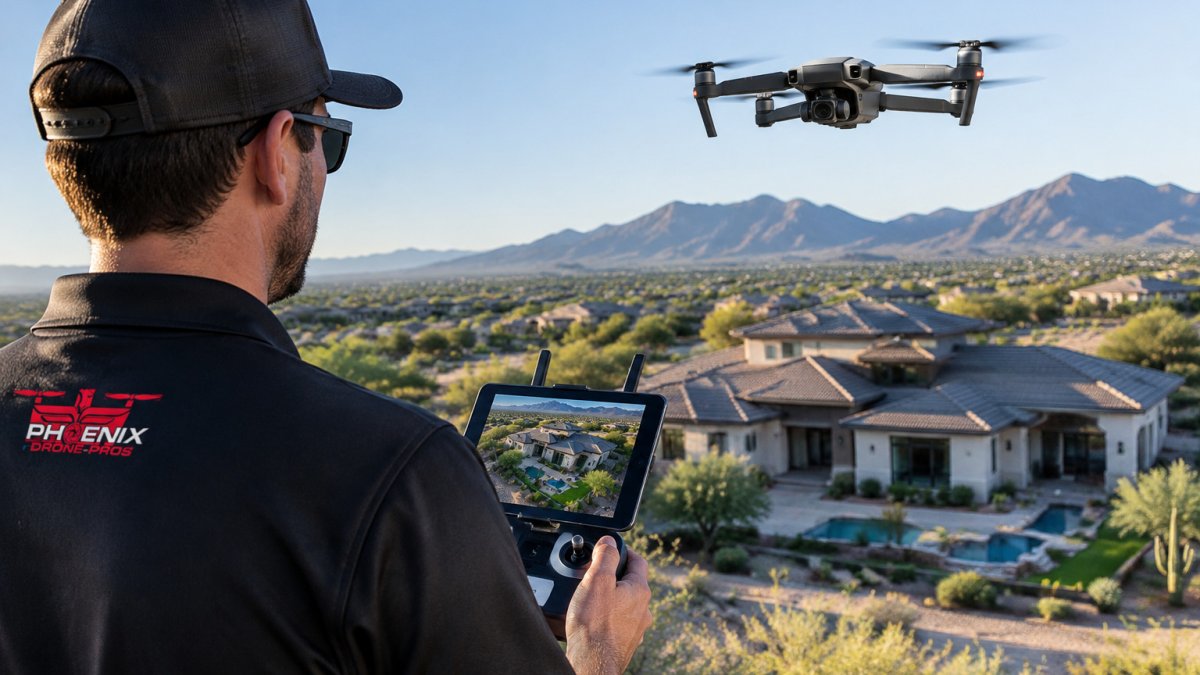
According to the National Association of Realtors 2026 industry benchmark, homes with aerial photos sell 68% faster than those without. That single number explains why aerial footage has moved from luxury add-on to standard listing tool. At Phoenix Drone Pros, we see the difference on every shoot: a buyer scrolling listings on a phone stops on the overhead shot that shows the lot, the pool, and the mountain view in one frame.
Aerial footage is drone-captured video and still imagery that shows a property from above, giving buyers a clear read on size, layout, and surroundings. It answers questions a ground photo cannot.
The payoff shows up across the funnel:
- Listings with video content receive 403% more inquiries, per Amplifiles 2026 data
- Properties with drone photography are 65% more likely to get in-person showings, according to Matterport 2026 research
- 82% of real estate agencies now use drones for marketing, per Matterport's 2025 adoption figures
Below, we break down the full workflow, from shot list to distribution to ROI.
Planning Your Drone Shoot: What to Capture and Prepare
A strong drone shoot starts with a shot list, not a spontaneous flight. Send your pilot the listing details, the property boundaries, and the three features buyers care about most. Then prep the property: clear the driveway, close the garage, and tidy the yard.
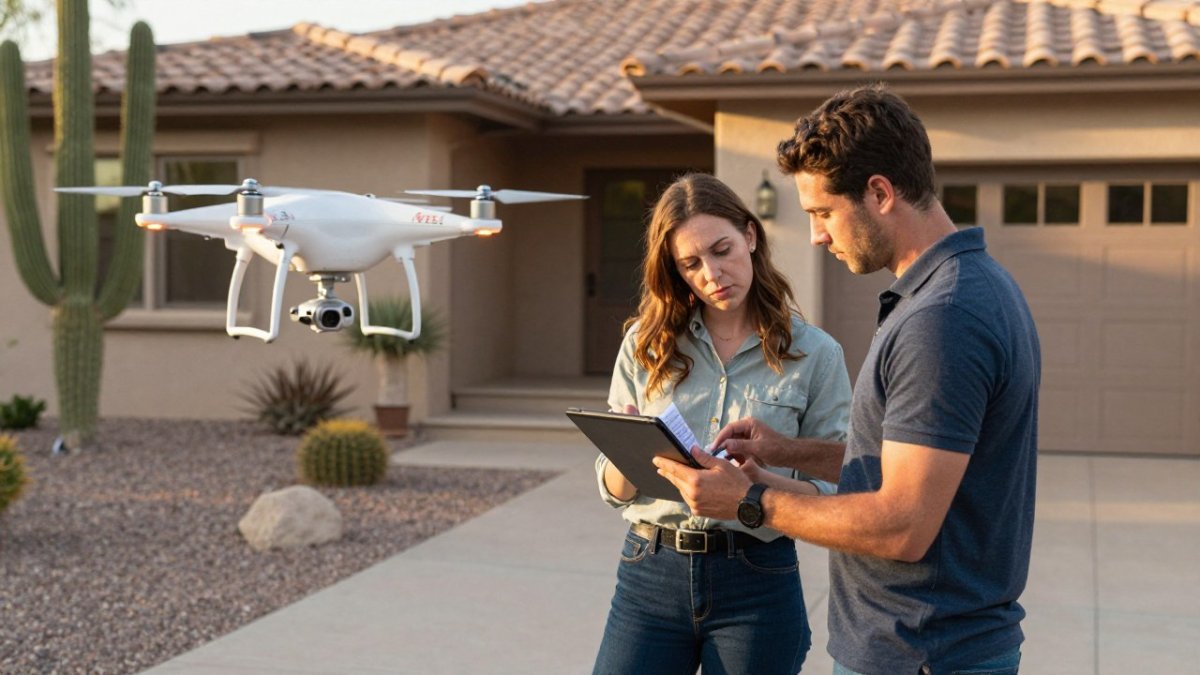
A good aerial image shows scale, and scale means nothing if the shot blurs where the lot ends. For a full prep walkthrough, see how to prepare a property for aerial filming.
Shot List: Establishing, Approach, and Detail Angles
Build every shot list around three angle types:
- Establishing shot: a high, wide frame that shows the whole lot, the street, and the surrounding area
- Approach shot: a low, smooth pass toward the front of the home that mimics a buyer driving up
- Detail angles: tight overhead frames of the pool, patio, landscaping, and access roads
Shoot the establishing and approach shots at golden hour for warm light and long shadows. Detail shots work best at midday when the sun is high and the lines are clean.
Real Estate Drone Photography License and Compliance
Legal commercial drone work in the U.S. requires an FAA Part 107 remote pilot certificate, and the operator must follow airspace rules near airports and controlled zones. Ask any pilot for that certificate and proof of insurance before you book.
Compliance does not stop at the certificate. Two more rules matter for listings:
- Privacy: avoid capturing identifiable neighbors or their private spaces
- Disclosure: some brokerages require a note that images are enhanced or drone-captured
The FAA's Part 107 rules for small drones set the baseline every operator must meet. Our pilots are FAA certified and fully insured. For the full checklist of what a compliant pilot must carry, read the legal requirements for commercial real estate drone pilots.
Real Estate Aerial Photography Examples That Convert
The shots that convert are rarely the prettiest ones. They are the ones that answer a buyer's question before it gets asked.
Three examples that work again and again:
- The lot-size frame: a straight-down shot that makes the property boundaries obvious
- The lifestyle frame: a low pass over the pool, deck, or outdoor kitchen at dusk
- The location frame: a wide shot that ties the home to nearby amenities, parks, and highways
What most guides miss is the order. Lead your gallery with the location frame, follow with the establishing shot, and close with detail. Buyers want context first, then the home, then the finishes.
How to Market Real Estate Listings With Aerial Footage Online
Distribution is where most agents leave money on the table. The footage gets shot, uploaded once, and forgotten.
Step 1, MLS and listing page first. Upload the hero video as the lead media, above the still gallery, and set the opening frame as the thumbnail so the overhead establishing shot is what buyers see before they click.
Step 2, Property website and landing page. Embed the full hero video and a second, longer cut (two to three minutes) for buyers who want the complete walkthrough. Keep the hero video muted and autoplaying, with captions burned in, because most visitors watch without sound. Place a showing-request form directly below the player rather than in the site header.
Step 3, Social cut-downs. Pull three to five 15- to 30-second clips, each built around one feature: the lot and boundaries, the pool or outdoor living area, the approach and curb appeal, and the location context.
Step 4, Email. Send the hero video to your buyer list with a subject line that names the single standout feature ("New listing: 2 acres with a private pond"). Keep the email to one video, one image, and one button. A common pattern is a 48-hour follow-up to non-openers with a different clip, which costs nothing and often outperforms the first send.
Step 5, Paid campaigns. Put a modest budget behind the best-performing organic clip, most agents test $50 to $150, and target a local buyer profile by geography, age, and home-value range.
Step 6, Reuse everywhere else. The same footage feeds your listing presentation, open-house screens, printed flyers (pull a still frame), and your agent bio page. Agents marketing higher-end properties can go deeper with a dedicated playbook on how to market luxury homes aerially. For commercial listings, a Video Offering Memorandum packages that same aerial footage into a format built for investor audiences.
Watch out: uploading the same 16:9 file to every channel is the most common mistake, vertical platforms crop or letterbox it, and the property ends up half out of frame. Export a native aspect ratio for each destination before you post.
Real Estate Listing Video Length: How Long Should Your Drone Video Be?
The ideal real estate listing video runs 60 to 90 seconds. That window shows the property, the location, and the key features without losing a scrolling buyer's attention. Social clips should run 15 to 30 seconds; full property tours can stretch to two or three minutes. Keeping the exterior crisp in those brief clips helps the property make a strong first impression, and Simply Superior Window Cleaning can be part of the preparation behind polished exterior photos.
| Video Type | Ideal Length | Best Platform | Primary Goal |
|---|---|---|---|
| Social teaser | 15-30 seconds | Instagram, Facebook | Clicks and views |
| Listing hero video | 60-90 seconds | MLS, listing page | Inquiries |
| Full property tour | 2-3 minutes | YouTube, website | Buyer interest |
| Luxury showcase | 2-4 minutes | Landing page, email | Showings |
Keep the edit tight. Open with the establishing shot, cut to the approach, then land on details. Hold each shot for at least three seconds so the footage stays smooth. For a deeper look at editing and sequencing, read our guide to professional drone video for property listings.
Measuring Performance and Return on Investment
Track a few core numbers to know whether your aerial footage is earning its keep: views, clicks, inquiries, and days on market. Compare listings with drone media against your own listings without it, and watch the gap.
A simple tracking sheet works:
- Video views on the listing page
- Social clicks to the listing
- Inquiries mentioning the video
- Showings booked in the first two weeks
- Days on market versus your average
To turn those counts into a return figure, calculate cost per lead. Add what you paid for the shoot to any paid-boost spend, then divide by the number of inquiries or showing requests the listing generated in its first 30 days.
A few practical rules keep the comparison honest:
- Use a fixed window. Measure the first 14 and 30 days on market for every listing, not whatever period happens to look best.
- Separate organic from paid. Report views and clicks from your listing page apart from boosted social, or the paid spend will flatter the organic result.
- Ask the inquiry source. Add "How did you find this listing?" to your showing-request form so video-driven leads are identifiable.
- Compare like with like. A luxury property and a starter home will not produce the same inquiry volume; compare each listing to your own average for that price band.
Run this for three listings and you will have a clear read on ROI. The real estate photography market is valued at $1.2 billion, per Gitnux 2026 market data, and buyers expect the quality that spend implies. Footage that lifts inquiries pays for itself on the first closing.
Watch out: counting raw video views as success is the easiest way to fool yourself, a view is not an inquiry, and a high-view clip that never produces a showing request is a signal to change the call to action, not to shoot more footage.
Scheduling Your Aerial Shoot With Phoenix Drone Pros
Booking a shoot should be simple. At Phoenix Drone Pros, our FAA-certified, fully insured pilots have more than 10 years of commercial drone experience, with local pilots available in Phoenix and San Antonio.
Here is what you get on every real estate job:
- Stunning aerial footage built from your shot list
- A detailed, accurate view of the property and its boundaries
- Access to difficult-to-reach areas
Pricing depends on the shot list, dates, and delivery, so request a quote for current rates. If you would rather keep flights in-house, our drone flight training covers the skills and certification prep to fly your own listing shoots. Read our complete guide to booking professional drone photography and get your shoot on the calendar.
The listings that sit on the market are usually the ones buyers cannot picture. Aerial footage fixes that in a single flight. Phoenix Drone Pros brings FAA certification, full insurance, and 10+ years of commercial drone experience to every shoot, with local pilots in Phoenix and San Antonio.
Frequently Asked Questions
How do you use drone photography to market a real estate listing?
Start with a shot list that covers the establishing view, property boundaries, lot size, and nearby amenities. Pair 8 to 12 aerial images with a 30 to 60 second video tour. Publish the aerial footage as the lead photo or first video on the MLS, then repurpose it for Facebook, Instagram, and your listing presentation. Aerial footage works best as the centerpiece of a listing rather than an afterthought.
Do you need a license to take drone photos for real estate?
Yes. Any commercial drone flight, including real estate photography, requires a remote pilot certificate under FAA Part 107. The pilot must pass the knowledge test, register the drone, and follow airspace rules such as altitude limits and no-fly zones. Hiring a certified and insured operator protects you if something goes wrong on the property. Ask for the certificate and proof of insurance before the shoot, and confirm the operator carries liability coverage that names your brokerage if required.
How long should a real estate listing video be?
Keep the main listing video between 30 and 90 seconds. The first 3 to 5 seconds should show the strongest aerial establishing shot, because it is the first thing buyers see. Use a 15 to 30 second cut for Instagram Reels and Facebook, and a 60 to 90 second version for the MLS and YouTube. Longer cinematic edits work for luxury properties, but only when every second adds new information about the home or its location.
How much do realtors pay for drone footage?
Pricing depends on the number of shots, property size, travel distance, and delivery timeline. Phoenix Drone Pros does not publish fixed rates because every listing is different. Request a quote with your property address, square footage, and deadline to get accurate pricing for your shoot.